

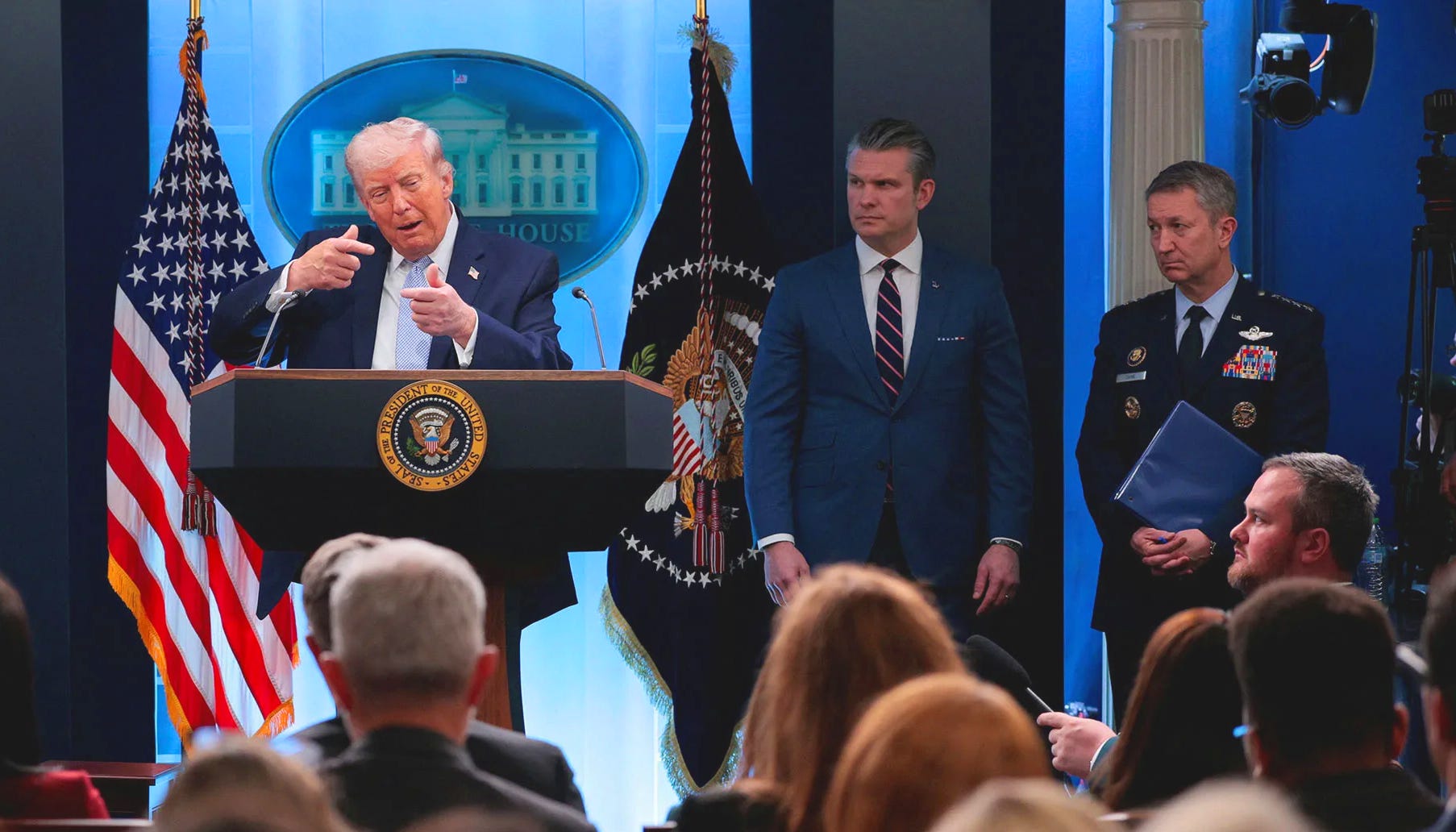
On Wednesday night in Gastonia, North Carolina, the President of the United States told a rally crowd what he thinks of their fuel bills. Gasoline above four dollars a gallon, he said, is “a very inexpensive price to pay,” and he added that it would be worth paying at a good deal more. The national average the next morning stood at $4.43, up more than $1.20 from a year ago. Diesel, the fuel that moves nearly everything Americans eat and wear, had just set a record.
This sentence is revealing because I think it’s a request. We’re seven months into a war with Iran (that Congress never constitutionally declared, mind you), and here’s the president suggesting Americans should (continue to) sacrifice for the cause.
Americans have rarely flinched from burdens they felt were necessary. The generation that fought World War II accepted ration books, surrendered its spare tires, and crawled along at a “victory speed” of thirty-five miles an hour on a few gallons of gasoline a week. They bought bonds, planted gardens, and shipped their sons overseas. They did so because they mostly understood what the war was for, who had started it, and what its end would look like. Sacrifice follows conviction. When a cause is clear and clearly just, people will be more willing to bear the burdens placed upon them. When it is neither, they will rightly refuse (and no amount of presidential persuasion will move them).
Republican officeholders have spent the year testing this proposition—trying, in other words, to get voters to believe that the US military’s intervention in Iran is just and deserving of their support. Rep. Buddy Carter called the pain at the pump “a small price to pay.” Sen. Ron Johnson argued it’s worth it. “If we can stand the pain of the rising cost of energy, we need to stay the course,” Sen. John Kennedy assured Americans. Sen. Roger Wicker, chairman of the Armed Services Committee, announced that “the public understands the necessity of what we’re doing.”
(Each of those lawmakers, mind you, treated high gasoline prices under Biden as a grave, administration-made burden on ordinary Americans—calling them “astronomical,” saying families “can’t afford it,” and depicting Biden’s energy policy as a “campaign against the American family.”)
The public isn’t buying it. A Fox News poll released last week found that 60 percent of voters call the war the wrong decision, and 71 percent say the administration has no clear strategy for ending it. That second figure includes 83 percent of independents and 43 percent of Republicans. Nearly half of voters now believe the war will leave America less safe, up from 39 percent in April. A New York Times survey taken the same week found more than three-quarters of independents, and nearly a quarter of the president’s own 2024 voters, disapproving of his handling of the conflict. In January, 72 percent of Republicans said the economy was better than it had been a year earlier. Today 29 percent do.
The base is moving as well. In May, Politico found half of self-described MAGA voters willing to continue the war even if it raised costs at home. By July that share had fallen to 37 percent.

Why the refusal? Consider what the public has been asked to believe. The president has declared this war won several times over: in its first hour, again in March, in April as a “total and complete victory,” and in June with a deal he pronounced finished. And yet after each pronouncement, shooting resumed. The objective has been all over the map: ending a nuclear program the administration claimed last year to have obliterated; toppling the regime; destroying missiles; and reopening the Strait of Hormuz (a waterway that was open before the first bomb fell…). According to the Congressional Budget Office, this war of choice has already cost $38 billion (and eighteen American lives), with $3 billion in costs (and more lives?) added each month. A people cannot commit to a cause its own authors are unable to define.
And yet people’s opinions are rarely reflected in the votes cast by their purported representatives. Last Tuesday the House voted 220 to 204 to direct the president to end hostilities. Seven Republicans joined the majority. Seven. Over two hundred of their colleagues voted to continue the conflict. (The Senate, which has buried every such measure, stands ready to bury this one, too.) The Pentagon, meanwhile, has asked for another $88 billion. (You know, because they manage their budget so well…)
In short, on this issue there’s a large chasm between the sentiment of economically struggling voters and the politicians dismissing their concerns with platitudes of sacrifice and staying the course. And within that chasm live, comfortably, the interests that prosper from permanent war.
Republicans were warned. In a South Carolina debate hall in May 2007, Ron Paul spoke a simple truth: that the September 11 attacks were “blowback,” the CIA’s own word for the unintended consequences of intervention. Rudy Giuliani famously demanded a retraction, clutching his pearls. Dr. Paul refused, and delivered one of the rare teaching moments a debate stage has produced. He pointed to the CIA’s 1953 overthrow of Iran'‘ government and summarized the matter in eight words: “They attack us because we’ve been over there.”
The attendees cheered Giuliani in the moment (full of militaristic fervor and post-9/11 fury). But the country, slowly, sided with Dr. Paul. He out-raised every Republican rival in the final quarter of 2007, and the young people he drew into politics began returning the right to its older, non-interventionist roots. That shifting of the Overton window allowed Donald Trump, nine years later, to tell Jeb Bush on a debate stage that his brother’s administration had lied the nation into Iraq, and to win South Carolina’s primary a week later.
The promise of no new wars helped assemble Trump’s victorious 2024 coalition, libertarians (and me) included. The coalition now lies in rubble. We were promised prosperity and peace. We received tariffs and Tehran.
There is, perhaps, a hopeful reading of the polling numbers: many voters have learned what their representatives have yet to. The instinct Ron Paul awakened in 2007 now outranks any single politician, the president included. It runs strongest among the young, who have never (!!) known a year in which their country was at peace in the Middle East.
But that instinct has few friends among Republican officeholders. There are seven in the House. In six weeks, the voters will have something to say about the rest, and Republicans who wish to survive November might begin by believing their own constituents, who are telling pollsters that the war’s cause is unclear, the cost is real, and their patience is spent.
The president calls four-dollar gasoline a very inexpensive price. Americans have willingly paid far dearer ones for causes that deserved them. Their objection to paying this one is a judgment on the war itself, one whose purpose is neither clear nor clearly just. Wise leaders (who are sadly in short supply in our era) would accept the verdict and extricate the US from this war of choice.