

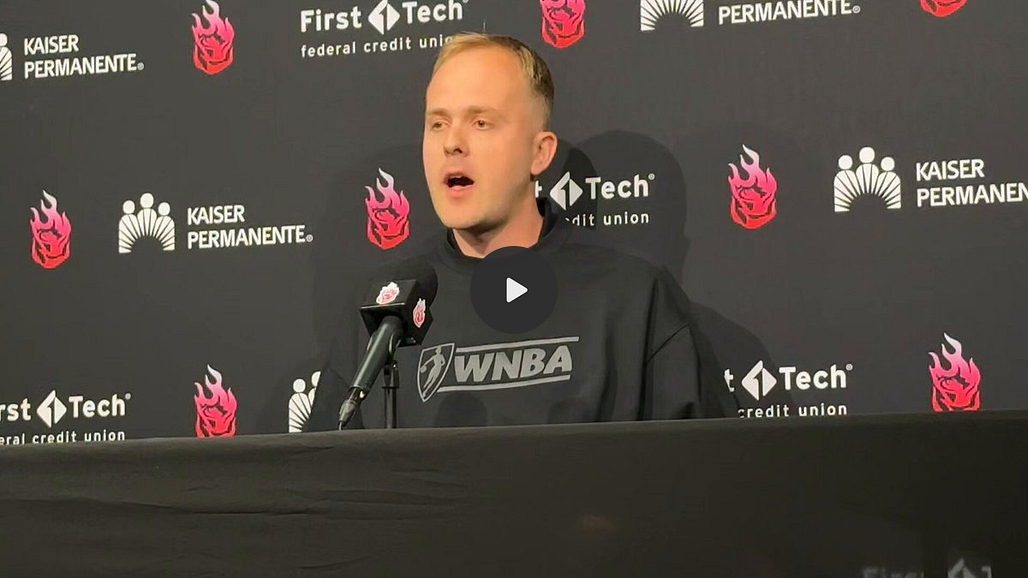
On Friday night, after her team’s win in Portland, Indiana Fever coach Stephanie White was asked a question that would have puzzled nobody a generation ago: should biological males compete in women’s sports? “I don’t know that I would say I’m educated enough from a scientific standpoint,” she began. Then: “I don’t ever believe that exclusion is the answer.”
The question was hardly ambush journalism. White’s own guard, Sophie Cunningham, has spent the past two weeks at the center of a national argument after saying she wants to protect young girls from having to compete against biological men. Supporters have rallied outside consecutive Fever road games. Counter-protesters have shown up too. And a Seattle Storm co-owner was suspended by the league over a courtside confrontation with two of Cunningham’s young fans.
Understandably, Coach White expressed frustration that the controversy keeps following her team. But her answer merits a closer look, because it tells us something important about the moment we’re in.
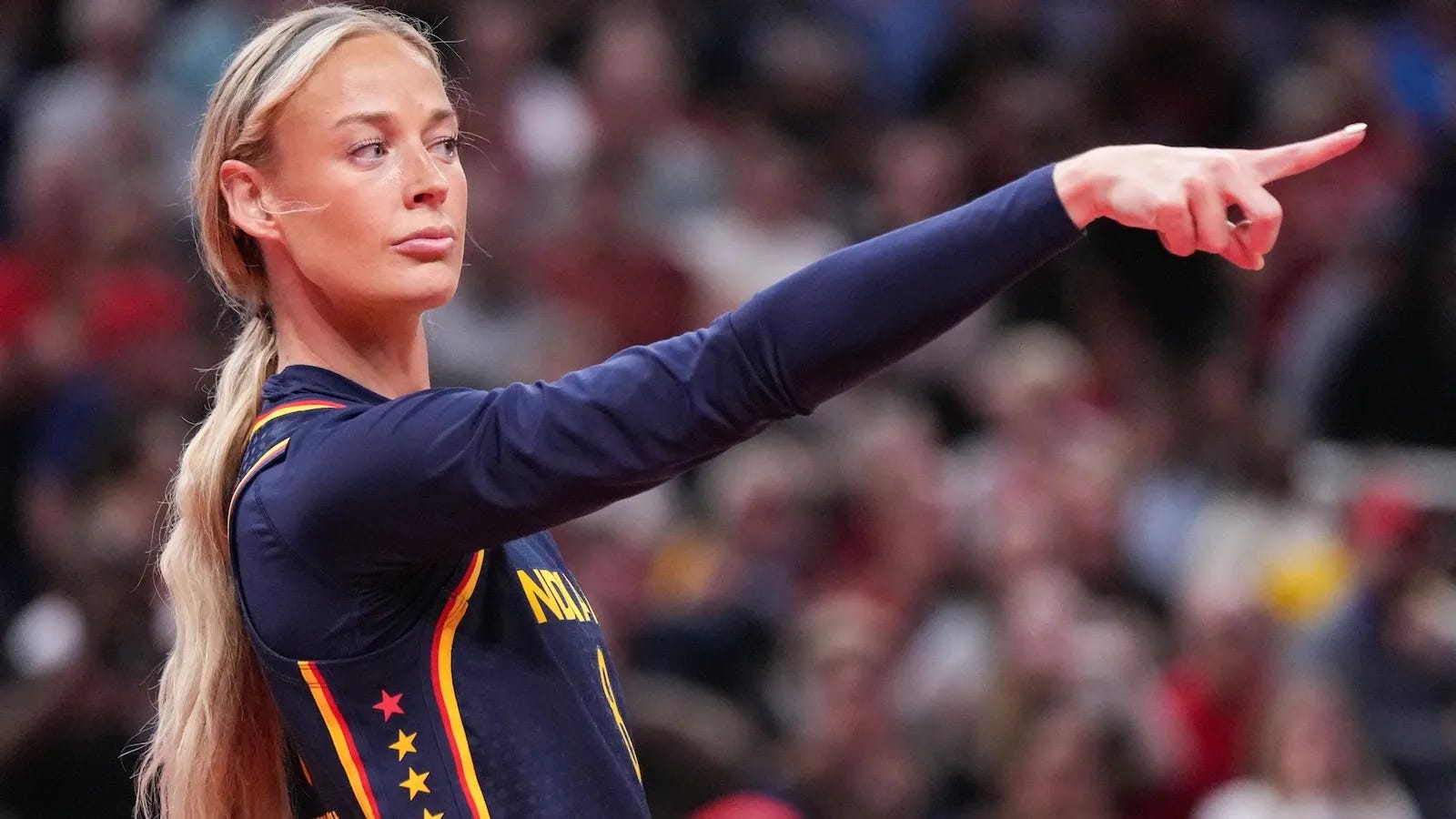
Let’s start with the claim that exclusion is never the answer, offered by a woman whose paycheck is signed by, yes, the Women’s National Basketball Association. Her employer—nay, her career—is predicated upon exclusion. The WNBA keeps men out, for the obvious reason that if men were let in, no women would be left on the court. That category is also why her (consistently unprofitable) league exists at all.
Every category in sport is an exclusion, and deliberately so. Weight classes exclude heavyweights from flyweight bouts. Age brackets exclude eighteen-year-olds from twelve-and-under leagues. The Paralympics exclude Olympians. Roster cuts exclude the insufficiently skilled, which is to say that Coach White administers exclusions herself during every training camp, and is paid well to do it rigorously. Exclusion is the architecture of fair competition. Abolish it, and the obvious result is a single open division in which nearly every woman, every lightweight, and every child is eliminated in the first round.
Exclusion is the architecture of fair competition.
Coach White confessed scientific ignorance on this topic, as if responding to the question required first taking college-level courses on basic biology. Nonsense. What is readily apparent to any competent person (White included) is that male puberty builds a different machine. Testosterone running roughly fifteen to twenty times higher than in females yields greater lean muscle mass, some thirty percent more upper-body strength, denser bones and longer levers, larger hearts and lungs, higher hemoglobin concentration for carrying oxygen, a greater share of fast-twitch muscle fiber for explosive movement, and thicker tendons to absorb the resulting force. A standard peer-reviewed review of this evidence places the resulting performance gap at ten to fifty percent depending on the sport, widest in events rewarding upper-body power. The coach need not have read the paper. She has watched the phenomenon every day of her professional life.
In 1998, Serena and Venus Williams suggested they could beat any man ranked outside the world’s top 200. Karsten Braasch, a chain-smoking German journeyman ranked 203rd, warmed up with a round of golf and a couple of drinks, and then beat Serena 6–1 and Venus 6–2. Serena, to her credit, later conceded she would never stand a chance against a man inside the top 100.
Two other quick examples. Last year the Switzerland women’s national soccer team played a friendly match against FC Luzern’s under-15 boys. The boys won 7–1. And the women’s world-record time for running the 100-meter sprint—10.49 seconds set clear back in 1988—is slower than what hundreds of high school boys achieve each year.
These examples don’t diminish female athletes, whose excellence within their category is the whole point of having the category. Rather, these examples reveal why the category exists in the first place.
So when an accomplished basketball professional claims she lacks the scientific education to say whether men should play in women’s leagues, we ought to ask what is actually happening. In Orwell’s 1984, the Party’s final and most essential command, he wrote, was “to reject the evidence of your eyes and ears.” Winston Smith’s captors did not merely demand his obedience; they demanded that he sincerely see five fingers when four were held up. The regime understood that a citizen who trusts his own perception (or who feels comfortable saying what those in power do not want said) is a citizen not yet fully governed.
Coach White’s demurral has distinguished company. At her 2022 confirmation hearing, Supreme Court Justice Ketanji Brown Jackson was asked to define the word “woman” and answered, “I’m not a biologist.” Here was a Harvard-educated jurist, nominated in part because she is a woman, professing herself unqualified to say what one is. The pattern repeats across our discourse: a demand for credentials no one actually needs, deployed to avoid a statement everyone actually understands. Call it strategic incomprehension. It appears whenever plain observation collides with ideological requirement, and its function is to make conversation impossible. You cannot reason with someone about basic biological differences if they claim, with a straight face, not to grasp observable, self-evident realities.
The broader debate surrounding gender identity contains some tough questions. How adults with gender dysphoria ought to be regarded and treated, to what degree social contagion has pushed this trend onto impressionable youth, and where medicine ends and ideology begins: reasonable people dispute these things, and should. But the sports question sits at the shallow end of that pool. It merely requires eyes, and the willingness to believe them. That is why it has become the issue on which the ideological edifice is cracking first. A New York Times poll found 79 percent of Americans, including 67 percent of Democrats (!!), opposed to biological males competing in female athletics. When a question is this easy, the refusal to answer it stops being a position and becomes a confession.
A confession of what, though? Rarely of sincere belief. White’s answer had the cadence of a prepared statement, as if she had rehearsed it, in anticipation of the topic being brought up, to survive a press scrum without generating a headline. (She failed.) What White’s answer revealed is fear: fear of the activist faction that polices her league, fear of the professional consequences that have befallen plainer speakers. That fear is the deeper indictment of the orthodoxy in question. A movement confident in its claims does not need coaches to feign ignorance of their own sport, or judges of their own sex. Compelled absurdity is the tribute weakness pays to truth.
The response by Portland’s head coach highlights this fear (“I’m completely supportive of everyone!”), showing how people choose to beclown themselves in order to avoid outrage from the mob:

Which brings us back to Sophie Cunningham, who chose the other path. Pressed to soften her remarks, she declined: “I said what I said. I think it’s kind of common sense. I stand on what I said.” For this she has absorbed abuse that would wilt most public figures. But watch what followed. Rallies at each consecutive game. Fellow athletes, and quietly many more, discovering that the obvious thing can be said aloud, and that the sky does not fall when it is.
While Orwell diagnosed the disease, Aleksandr Solzhenitsyn prescribed a cure. On the February day in 1974 that Soviet agents came to arrest him, he released an amazing farewell essay to his countrymen titled “Live Not by Lies.” Tyranny ages quickly and grows unsure of itself, he argued, so it enlists falsehood to prop itself up, and falsehood asks something modest of ordinary people: daily submission. Starve it of that and the apparatus cannot stand. Nobody, he insisted, was obliged to march into the town square and shout the truth. It was enough to decline to repeat what one did not think.
That is a standard almost anyone can meet, including a coach at a podium, since withholding assent costs far less than heroism. And every person who withholds it lowers the price of honesty for the next.
Truth already has the evidence on its side; it wants only witnesses. The choice left to the rest of us is the one Cunningham has already made: to either say what we see, or to keep insisting, against the evidence of our own eyes, that we are not educated enough to understand our own biology.
Thanks for writing this
Wow, what a clear statement supporting observable truth.