

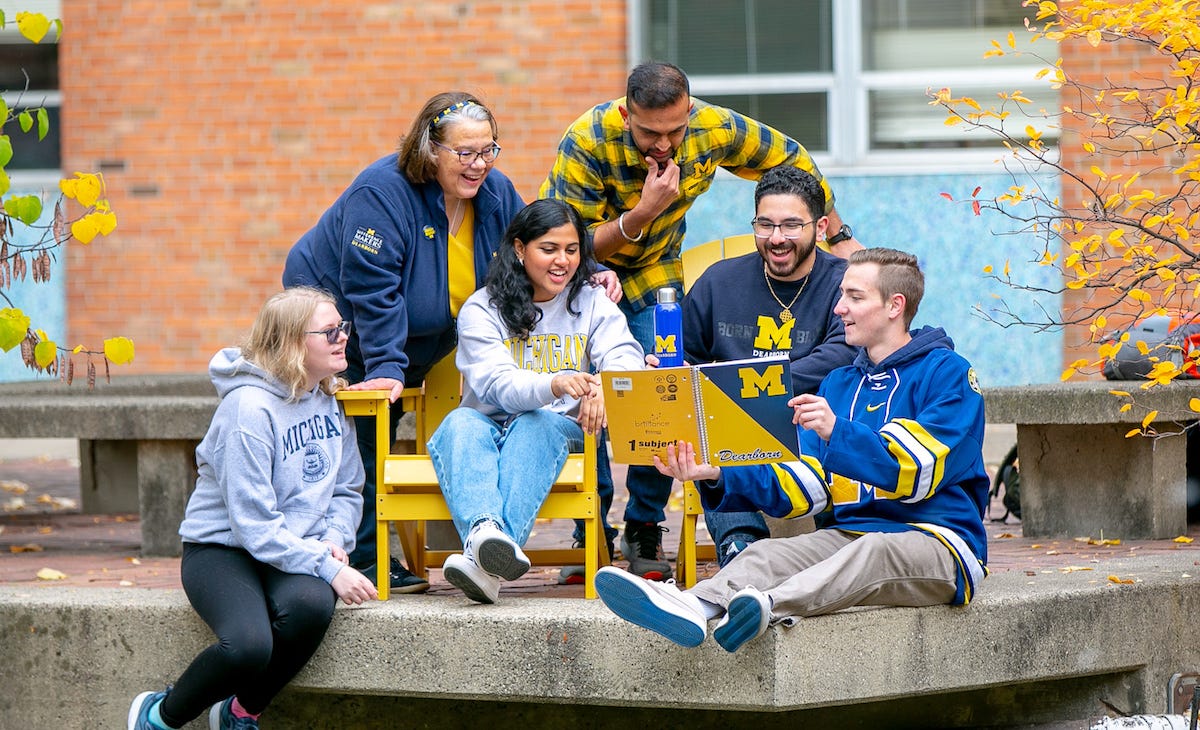
Beginning in the fall of 2027, roughly half of the University of Michigan’s incoming class will open their first transcripts to find something missing. Students in the College of Literature, Science, and the Arts, the university’s largest, will see no letter grades for their first semester. There will only be a notation of pass or no credit.
The stated purpose? To help students curb the “mental health crisis unfolding among college-aged individuals” and to let them explore hard subjects without fear that an early stumble will follow them for years.
Sure, freshmen arrive anxious to a new environment, and a bad grade right off the bat can feel discouraging. But a policy like this makes a claim about causes, and this one assumes that the pressure of being measured is what ails students. But what if grades do not produce so much of that anxiety as reveal it? What if a growing share of eighteen-year-olds find college overwhelming because they were never prepared for it, and the grade is merely the messenger?
Here’s some evidence to consider. Last November, a faculty committee at the University of California, San Diego, reported a steep collapse in the math readiness of its own admitted students. The share needing remedial math (i.e., high school-level math while in college) climbed from about one in two hundred in 2020 to roughly one in eight by 2025, and the remedial course had to be rewritten to cover material from middle and even elementary school! Shockingly, a quarter of the students placed into the lowest math course had earned a 4.0 in high school math, and nearly all had cleared their state’s requirements. Their transcripts indicated well-schooled students. Their placement exams indicated young people who could not reliably subtract simple fractions.
Michigan’s coddling of its incoming freshmen arrives amid a broader wrestling with grade inflation and remediation. Roughly a third of American college students land in remedial courses that earn no credit toward a degree, costing taxpayers some seven billion dollars a year. Those taxpayers are compelled to pay twice, in effect: once for a high school diploma that was supposed to certify college readiness, and again for colleges to reteach the same material to unprepared students.
These high school students, and their parents, are misled about their preparation largely because grade inflation makes the ‘A’ ordinary and the transcript therefore uninformative. Then in recent years, many universities dropped the SAT and ACT, and several went further and refused to consider scores at all, on the theory that the tests were barriers (duh?). As the data came in, that theory buckled. Dartmouth found that test scores predicted college performance better than high school grades did, and that dropping them had made it harder to spot promising students from struggling schools, the opposite of what was intended. One selective university after another reversed course; nearly every school in the Ivy League has now restored a testing requirement, and hundreds of faculty across the University of California system are in open revolt against their own test-blind policy.


Here’s the point, put simply: a generation is being advanced through a schooling system on paper credentials that increasingly overstate what lies beneath, financed by federal student loans that flow regardless of preparation or progress and that few borrowers fully understand when they sign. Institutions face little penalty for admitting unprepared students, because the money arrives either way.
Some have likened higher-education subsidies to the housing subsidies of the last decade, which coaxed people into homes they were not financially prepared to keep, and the comparison is apt. We are bundling underprepared students into degrees the way lenders once bundled shaky mortgages into securities stamped with high ratings, and calling the rising numbers progress. As we learned in 2008, the institutions involved often get bailed out and held harmless while individuals get the shaft.
None of this makes “pass or no credit” approaches inherently problematic. MIT has hidden first-year grades since 1968, and done so alongside legendary rigor. The question is what problem Michigan believes it is solving. Easing a genuinely hard transition (due to the rigor and expectations involved) is surely a defensible goal. Coddling students in the name of a mental-health emergency, whose deeper source may be unpreparedness itself, is not.
So who, then, is to blame? Simple: the blame rightly rests on the adults who found it easier to pass a young person along than to tell that person the truth. Kindness of that sort compounds into cruelty (the so-called “soft bigotry of low expectations”), saddling unprepared students with significant debt as they struggle along the way. The actually generous act is to prepare people for reality, and reality keeps no covered grades to soften its blow. In the world these students are entering, the project ships or it does not, the client stays or leaves, and no registrar hides the result. Welcome to real life, kids.
Some institutions are already choosing the harder, better road by restoring honest signals, as the return of the SAT shows. Others are being built outside the credential machine altogether. Our Praxis program, for example, spends about eight months turning motivated young people into working professionals through real projects and a paid, guaranteed job at the end, on the conviction that proof of what you can do beats paper that says you once learned something. (Shocking, right?) We assume the young are capable of hard things, and then ask hard things of them, which is how capable adults have always been made.
Libertas Network acquired Praxis last year in order to advance our mission to help families flourish—in this case, through an efficient, effective alternative to college whereby young adults can quickly enter into the job market, typically debt free, and gain over three years of extra time to begin building their lives. (Between avoiding college tuition and those additional years of earned income, Praxis has a $300,000+ impact on each graduate’s life!) We believe the school system is broken and, with respect to so-called “higher education,” Praxis is how we’re offering solutions to the prevalent problem.
The goal of a college should be to prepare young people for a demanding world, and that work requires telling them honestly how they are doing. A grade is one of the few honest signals a student gets. Removing it does not solve the problem that so many freshmen are underprepared; it just makes that problem easier to ignore for another semester. The students would be better served by schools that hold the standard and then do the hard work of helping them reach it. Lowering the bar has never once produced a capable adult.
P.S. Praxis’s next cohort begins September 14. If there's a young adult in your life ready to be prepared rather than protected, and to build proof of what they can do instead of paper that says they did, point them here before it fills.
Quite true, as you say, that "The goal of a college should be to prepare young people for a demanding world, and that work requires telling them honestly how they are doing." In my college freshman Chemistry 101 class, a few decades ago many, maybe most, of the students were hoping to go to medical school. Only 1 in 5 applicants were being admitted to med school then, and you needed good grades in the basic sciences. At the end of the first semester of basic college chemistry, about half my pre-med classmates, most of those who couldn't get at least a B, dropped chemistry and were looking at alternative career paths.
If they hadn't gotten those honest Cs, Ds, and Fs in basic chemistry, many of those students might have wasted years instead of one semester pursuing a career they weren't suited for. Or if the medical schools and licensing exams became similarly corrupt, might have ended up being frustrated, incompetent physicians?
There are probably better culling methods than Chem 101. A day or two of pre-college aptitude testing and counseling comes to mind. But that would not have worked for many of us—the males at least—because, at 18, we were bullet-proof and invincible. There's no substitute for honest signals, and the sooner they are given, the less time, money, and talent will be wasted in ultimately disappointing pursuits.
It is the ultimate disappointment to me, as a citizen, that so many of our colleges and universities have become so corrupt and degenerate that their registrars and administrators no longer know, and therefore no longer teach, the simple age-old enduring maxim, "Honesty is the best policy."
Well done, Connor! We will definitely consider Praxis for our children when they leave High School. Back in 2017, I predicted the college debt bubble would burst before then-parents of preschoolers need worry about it, crashing tuitions and sending many institutions to bankruptcy auction. I've only got a few more years before being proven wrong (or early) on that, but it's coming: https://inflationeducation.net/the-college-debt-bubble-and-six-rules-for-529-plans/