

It took three trips to JFK before I finally left New York last week.
The first, on Thursday, brought six delays and a cancellation; thunderstorms had settled over the region alongside a tornado warning. Every nearby hotel was booked, so I drove an hour away to find a bed.
The second attempt went sideways fifteen minutes after I walked through the doors on Friday, when the Federal Aviation Administration halted every departure in the country. Weather is weather, and nobody can sue the sky; I had no issue with Thursday’s delays, as annoying as they were.
I do have an issue with Friday’s FAA shutdown.
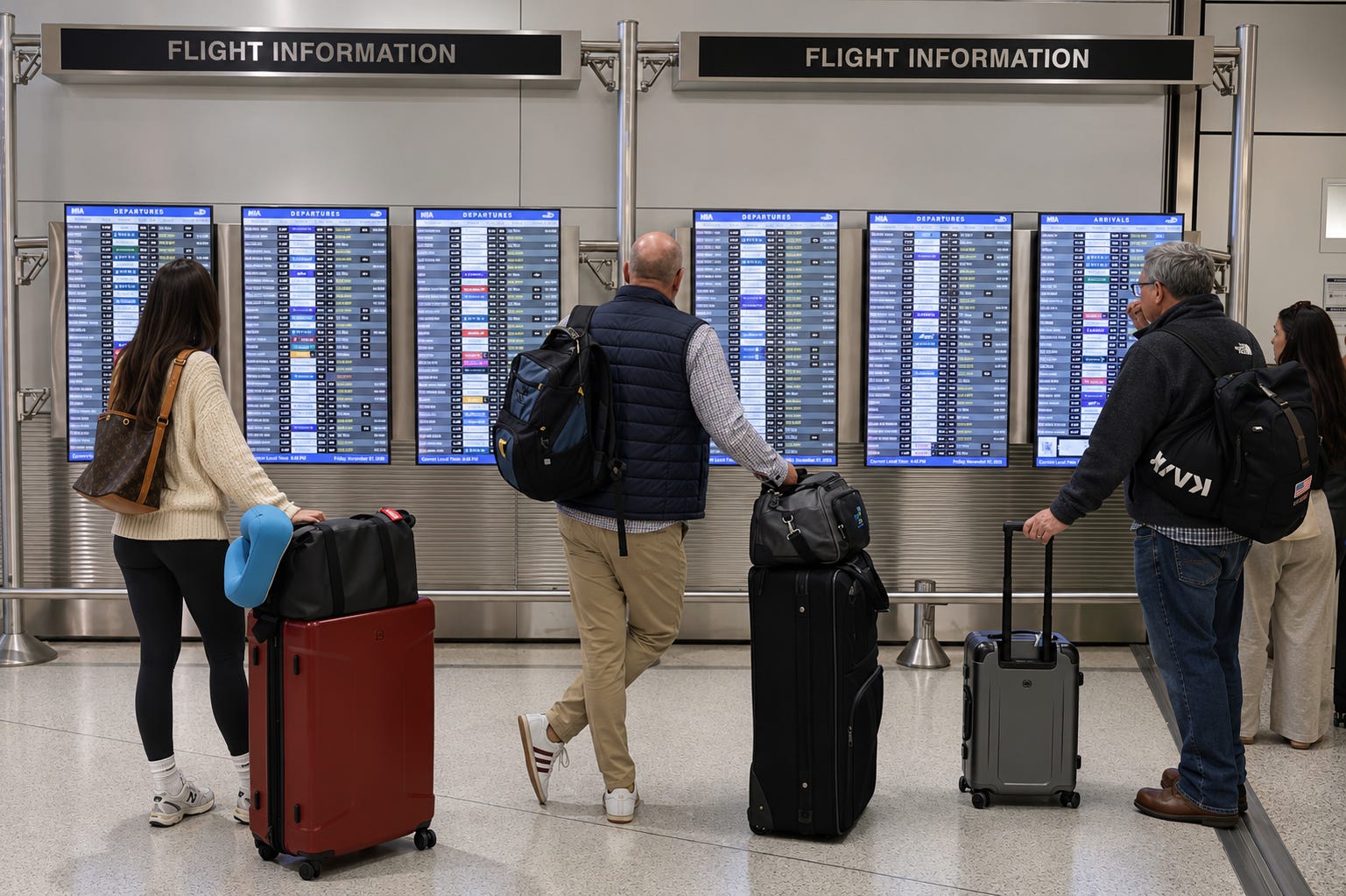
The nationwide ground stop lasted about four hours. By evening, more than 7,000 flights had been canceled and over 8,000 delayed. It was only the second such stop since 9/11. On Friday night, Transportation Secretary Sean Duffy blamed aging equipment: “We have old switches, old routers. We use 1980s little copper lines.” By Saturday, investigators traced the problem to a new router that a contractor had installed at a remote facility, part of routine work converting those copper lines to fiber optics.
The previous nationwide stop, in January 2023, came when contract workers accidentally deleted critical files in the system that warns pilots of hazards. That’s two national shutdowns in under four years, one caused by a few deleted files, the other by a botched router installation
When Thursday’s storm hit, the big news across the country was a Microsoft outage that knocked out the software that much of corporate America runs on. So as I reflected on all of these failures (including Jensen Huang’s ouster at NVIDIA and how central this one person had become not only to his company but to the broader AI industry), I recalled this xkcd comic depicting modern infrastructure as a wobbly tower of blocks, impressive and sprawling, resting at its base on a single slender piece:
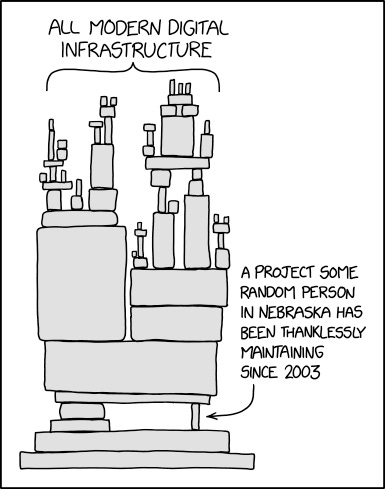
The joke lands because it describes a shockingly common feature of our modern era: impressively large systems that rely on some small potential point of failure. On Friday, the slender block was quite literally a router at a remote site.
Think about our food system. According to the USDA’s Economic Research Service, the four largest packers’ share of fed cattle purchases climbed from 36 percent in 1980 to 85 percent by 2012. What that concentration means in practice became clear in 2019, when a fire at a single Tyson plant in Holcomb, Kansas, shut it down for four months and sent cattle markets into turmoil.
Three years later, parents learned the same lesson more painfully. When Abbott’s Michigan plant closed over contamination, it took offline a large share of the supply from a company that held roughly 40 percent of the formula market. Shelves emptied. Mothers drove across state lines. And the shortage was worse than it needed to be because, as one analysis noted, a thicket of tariffs and regulatory barriers had left only about 2 percent of America’s formula supply coming from abroad.
How did a nation so wealthy become so fragile? The answer has two parts.
The first is the seductive arithmetic of efficiency. Consolidation lowers costs in ordinary times. One enormous plant is cheaper to run than six modest ones; one cloud provider is simpler than three. On a spreadsheet, spare capacity looks like waste. Consolidation has risks, but when things are working well, those risks are minor and worth the trade-off. Better to inconvenience a few people on rare occasions than to deny everyone lower prices and saved time. That arithmetic holds right up until the rare occasion arrives and the inconvenienced few turn out to be everyone.
The second part is monopolies that the government runs or protects. When Microsoft fails, its customers can and do leave; competitors are already circling. (“Apologies to all Gmail customers for not giving you the day off today,” Google’s director of product management snarkily wrote.) But when the FAA fails, there is nowhere to go. A 2024 Government Accountability Office review found that 51 of the agency’s 138 air traffic control systems were unsustainable, short on spare parts or funding or both. The FAA released its first comprehensive modernization plan in 1982. In the four decades since, the pattern has been overruns, delays, and modest results, and this September the GAO warned that another stumble would leave controllers on outdated equipment prone to outages and ground stops. Oops.
No private firm could survive forty years of that record. A government agency can, because its failures carry no consequences for the agency itself. The stranded passengers absorb the cost, and the following year’s budget request cites the breakdown as evidence that more money is needed. Little wonder that Duffy used the shutdown to chide Congress and demand $50 billion, up from the $30 billion he’d sought weeks earlier. Yet Friday’s breakdown came from the very upgrade work he wants funded, which suggests the deeper problem is design: a network so tightly coupled that swapping one component can stall an entire continent.


Must it be this way? Our northern neighbor answered that question thirty years ago. In 1996, Canada moved its air traffic control out of the government and into a nonprofit funded by fees on the flights it serves. Its revenue rises and falls with the service it provides, which gives it every reason to keep that service running. Tellingly, when Canada’s own pilot-alert system failed on the same day as ours in January 2023, its flights kept moving; controllers simply relayed the notices by phone. The lesson is clear: systems answerable to their users tend to modernize and adapt, and systems answerable to appropriations committees tend to stall and waste resources.
The broader principle reaches well beyond airports. Resilience comes from many suppliers, many routes, and low barriers for newcomers to join them. Every regulation that makes it prohibitively expensive to open a small meat processor, every import rule that shields an incumbent manufacturer, every licensing regime that freezes an industry in its current shape adds weight to the tower and removes the blocks that can help bear the load.
This is the reasoning behind the regulatory sandbox that Libertas Institute pioneered in Utah, an approach we’ve since helped many other states adopt. The premise is simple: give innovators a light regulatory touch so they can prove their ideas work and pose little or no risk to consumers. Their success then shows legislators and regulators which existing rules are needlessly onerous, especially for newcomers trying to break in.
Yet institutional reform is slow. What would the same principle look like at home, where we control the outcomes rather than merely enduring the ones government imposes? Put differently, what is the slender block barely holding up your own household?
For many families it is a single paycheck, a single grocery store, a refrigerator holding three days of food, a phone whose contacts live entirely in someone else’s cloud. Each is efficient, sure, but only until the moment something in the system fails. The ancient story of Joseph in Egypt endures for a reason: seven fat years are the time to fill the granaries, and the work looks unnecessary until the lean years make it priceless.
Preparedness of this kind is unglamorous. (I should know; I’ve spent 15+ years evangelizing it to fellow church members and neighbors, with the message mostly falling on deaf ears.) It means a pantry with weeks of food, decent cash on hand, a second way home, a skill or two that does not depend on an internet connection, and neighbors you know well enough to band together in tough times. It means teaching children that comfort is a gift from systems that can easily and totally falter, and that a capable person plans for the faltering. A household built this way is a small act of independence, one you can declare tonight.
Obviously we should demand that the institutions we cannot avoid, like the FAA, be opened to competition and held to account, so that one router can’t ground a continent. And we should arrange our own lives so that when the tower of modern systems sways, as it periodically will, our families aren’t balanced on a single block. I made it home on the third attempt (third time’s the charm?). Next time, I’d rather not need the luck.
Its interesting you said tariffs are part of the reason forth baby formula shortages. Perhaps tariffs are good to keep jobs in the U.S. but not when they create near monopolies.
Well said. Read this book to find out how to implement real robust optimization for companies and https://www.amazon.com/Decision-Factory-Novel-Decisions-Uncertainty/dp/B0GN94GQXG/ref=mp_s_a_1_1?adgrpid=186566966539&dib=eyJ2IjoiMSJ9.L2ZWAkC-4eVHXPXsY7h2kMEBcnFN6m2q9wKJ1nNKVum9kC5ePR6kj9VWLk_OUkR3Z6NZ4vXY1jKEi7CcaJcXJXsoUWpme9fl9cVnXmv5aq1IE0U193IZ1EXUUE8hjMNGYqeBbkFzoZhvv26d-tVciq22dv9FroDY03ET5jaFEV5YTkkfd7y2blEj_R4MDd5tADOFcpqYFkS-5WEWGKBoUg.sce2VFmxGX7FnNyBa2miJRGquzZasswecH_BrltqEwc&dib_tag=se&hvadid=779703259334&hvdev=m&hvexpln=0&hvlocphy=9016965&hvnetw=g&hvocijid=917556102685859114--&hvqmt=e&hvrand=917556102685859114&hvtargid=kwd-2490262656954&hydadcr=15153_13597729_1319840&keywords=the+decision+factory&mcid=003256d9949437c4821f8ef94cbda351&qid=1794852637&sr=8-1 even….