

Abdul El-Sayed won Michigan’s Democratic Senate primary last week, and he won it, by his own telling, for the working class. He campaigned as the tribune of the forgotten laborer, arrayed against billionaires and dark money.
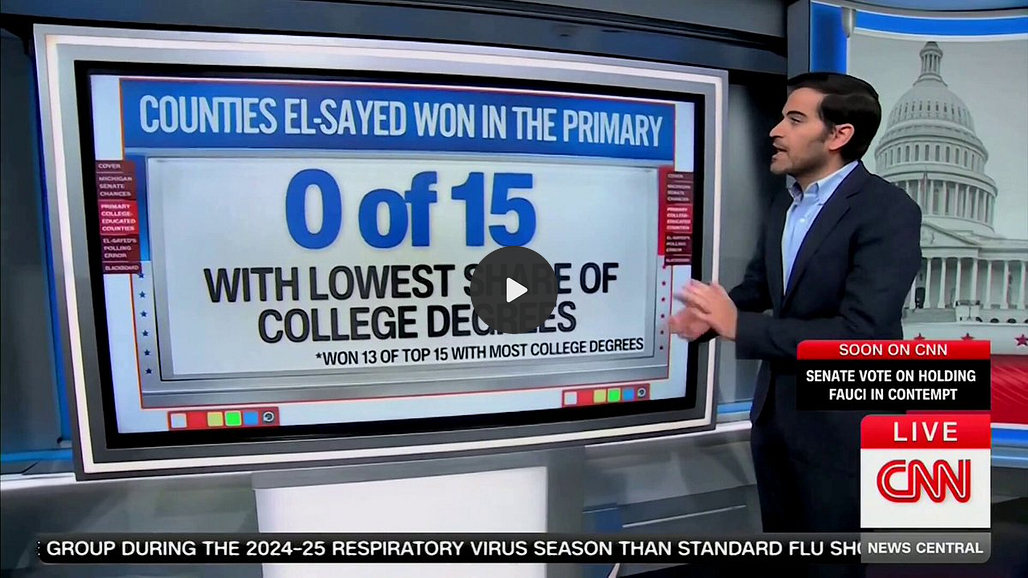
Then CNN examined where his votes actually came from. Of the fifteen Michigan counties with the lowest share of college degrees, El-Sayed won zero. Of the fifteen counties with the highest share, he won thirteen. Offered a champion, the workers politely declined. The credentialed class, however, accepted him with enthusiasm.

This is a pattern, and it is hardening. When Zohran Mamdani won New York City’s mayoral race last November, exit polling told the same story: 42 percent of voters without college degrees supported him, against 58 percent of college graduates. In Michigan, Bloomberg found El-Sayed took 54 percent of the vote in counties with above-average college attainment and 43 percent everywhere else. Wisconsin may extend the streak this week: the frontrunner for its Democratic nomination for governor is Francesca Hong, a Democratic Socialists of America member whose political home is Madison, the state’s college town par excellence. The engine of American socialism runs on college degrees.

El-Sayed, it should be noted, strategically refuses the socialist label. Pressed in a debate about the socialists filling his rallies, he answered: “I’m not a socialist. I’m just a capitalist who understands how capitalism works.” A man may call himself whatever he likes, but labels are the cheapest item in any campaign. His signature cause is single-payer health care, a government monopoly over every resident’s insurance. He campaigned alongside Alexandria Ocasio-Cortez, carries Bernie Sanders’s endorsement, and drew the debate question at all because his rallies are stocked with Democratic Socialists of America members. When the platform, the coalition, and the crowd all point in one direction, a self-description attempting to point in the other reveals less about the man’s economic views than about his brand management. Yes, he’s a socialist.
Why would the most schooled Americans embrace a thoroughly refuted ideology with a historically atrocious track record? The twentieth century ran the experiment over and over, in every climate and culture. Breadlines in Moscow. Famine in Mao’s countryside. Cuba’s slow rot. Venezuela’s blackouts. A hundred million dead is a robust sample size. Either universities have failed to transmit that record, or they transmitted something else in its place.
Anyone acquainted with the ideology’s pedigree will find it unsurprising, because Marxism has been a faculty project from the day it was drafted. It advertised itself as the creed of the proletariat, yet it was authored, financed, and propagated by men who rarely met one. Marx was a lawyer’s son who spent his productive years in the reading room of the British Museum, subsidized by Friedrich Engels, heir to a Manchester cotton mill. Lenin was a lawyer who taught that workers left to themselves would never rise above “trade union consciousness”; revolution required a vanguard of professional intellectuals to do their thinking for them. The worker was cast as the hero of the story and handled as a stage prop. And when actual workers spoke for themselves, the vanguard reached for rifles. The Kronstadt sailors who demanded in 1921 the freedoms they had been promised were shot by the workers’ state. The Polish shipyard electricians of Solidarity were answered with martial law. From the beginning, the masses were the marketing vehicle and little more.
Let’s illustrate the same concept in another situation to help us better observe it. Consider how teachers’ unions invoke children. Every strike and rally is “for the kids,” and these kids are cited as the reason why union members so vociferously oppose anything (school choice at the top of the list) that would threaten union members’ jobs. Whenever the interests of children and the interests of the profession diverge, as they did spectacularly during the prolonged pandemic closures, the children are tossed to the curb by their purported advocates. The child performs the same function for the union that the worker performed for Lenin: a sympathetic face borrowed to sanctify the pursuit of adult power and perks.
Turning back to the university—the petri dish culturing ideological contagion—we might cynically (though accurately) observe that taxpayers are being compelled to subsidize the very institutions that produce voters who demand more taxes. Your hard-earned dollars flow into a schooling system that, judging by its graduates’ ballots, now operates as the most effective socialist recruiting apparatus in American history. Colleges have become a perpetual-motion machine: subsidies in, ideology out, with votes cast for yet more subsidies. The people paying for the machine were never asked whether they wished to fund their own fleecing.
These taxpayer investments are justified on the basis that we need “an educated citizenry.” But schooling (which simply certifies that a person absorbed the consensus of the institutions he passed through) is not education, and graduates are, on the whole, profoundly historically illiterate.
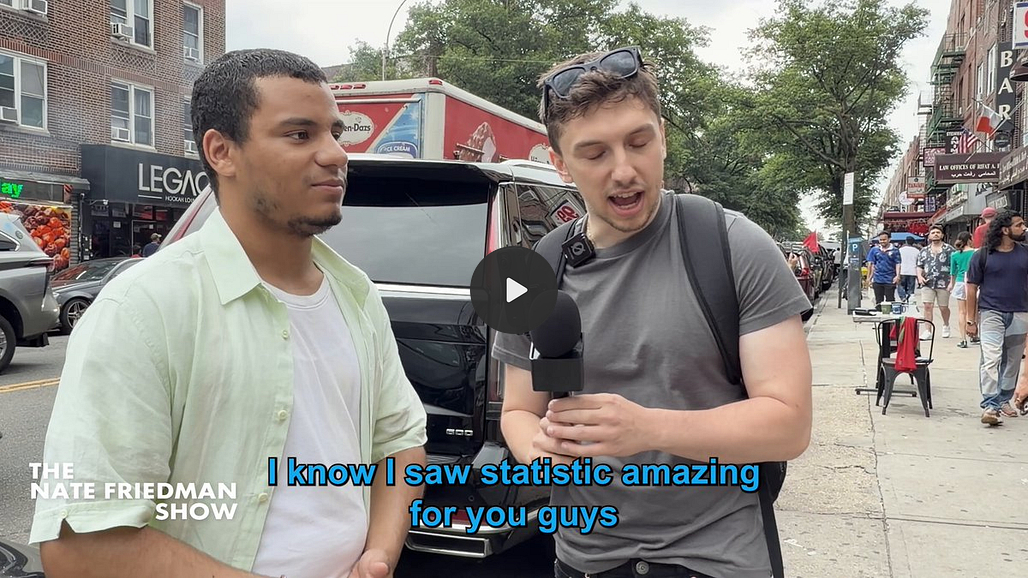
Consider a recent example offered by a young Democratic Socialists of America member who was asked to offer his pitch on socialism. “Community!” he responded. “Are you tired of sitting alone and being by yourself and having no one to talk to? Be a socialist! It’s all about community… to bond over the things that we love and share. That’s what socialism is.”
The pitch, for anyone with two spare brain cells to rub together, clearly conflates socializing with socialism, as though the abolition of private property were a book club. Churches, bowling leagues, and neighborhood barbecues have supplied community for centuries without requiring a single expropriation. A sales pitch that flimsy works only on customers who never learned what arrived after “community” in every socialist experiment on record: the queue, the informant, and the wall. This ideology thrives on the historical ignorance of its recruits—or, even worse, the absolute apathy these individuals show towards history.

What can we make of the fifteen counties whose Democrat majorities didn’t support El-Sayed? They are mostly poor, rural stretches of northern Michigan and the Thumb, places where degrees are scarce and paychecks are stretched thin. And Detroit told him the same thing: his opponent took more than 60 percent of the city’s heavily Black, working-class vote, and led by eight points across counties with sizable Black populations. These are the very people socialism names as its constituency, hourly workers and farmhands and home health aides doing grocery-store math at the end of every month. They know scarcity firsthand rather than as a seminar topic. The voters with the most to gain from the promise of free everything were the least persuaded by it. When the working poor of every race reject socialism while the richly credentialed embrace it, the reasonable conclusion is that one group received an education and the other purchased a counterfeit.
This credentialing machine runs on our money and our children, which means we can stop feeding it. Families can teach sound economics and true history at the kitchen table years before a campus makes its counteroffer; millions of parents raising their kids on the Tuttle Twins books are doing exactly that. Young adults can weigh apprenticeships, trades, and programs like Praxis that trade the credential mill for competence and a paycheck. Legislators can ask hard questions about why taxpayers underwrite institutions openly hostile to the taxpayers’ own interests.
Marx ended his manifesto by summoning the workers of the world to unite. Last Tuesday in Michigan, in their own fashion, they did. All fifteen of the state’s least-credentialed counties, farm and factory towns alike, looked over the newest vanguard sent to liberate them and united behind someone else. The revolution will have to be carried forward, as it always has been, by the people with the taxpayer-subsidized degrees and the borrowed grievances.
Our assignment is simpler: make sure the next generation is educated well enough to see through the credentialed class, however much schooling it receives.
Socialists have always been willing to airbrush out inconvenient people. Since the fundamental idea of statism is to get something for nothing, as long as statist schools continue to dominate, they will continue to train their students to expect something from nothing.
As a physicist, I’m trained to be skeptical of claims that violate of the second law of thermodynamics. Somehow, though, most physicists don’t apply that understanding of physical reality to politics. Most of them still want something for nothing.
Public education itself comes from a socialist impulse. The system is only doing what it was intended to do: indoctrinate students into statism and collectivism.
Lenin promised he would sell you the rope to hang yourself and he was proven right. He knew the wedges that could split society---look, free stuff!---and now they all do and welfare away. Who wouldn't vote for more free stuff? Or a privileged place in the eyes of the law and other institutions...
Interesting that you avoided the entire Muslim question here. Do you feel Marxism (etc) to be the larger threat?