

Garrett Langley runs Flock Safety, a $8.4 billion company whose AI-enabled cameras, more than 100,000 of them, now line the roads of over 6,000 American communities. Will Freeman is a software engineer whose open-source project, DeFlock, maps the locations of publicly visible surveillance cameras so individuals can see where they are being watched.
For this, Langley has called DeFlock a “terroristic organization” whose “primary motivation is chaos.”
Sit with that inversion for a moment. A billion-dollar enterprise photographs most cars in America (regardless of whether their drivers are suspected of a crime), logs each vehicle’s movements into a searchable national database, and grants access to thousands of police agencies, no warrant required. A private citizen responds by noting, on a map, where the cameras sit in plain view atop public poles. And in the CEO’s telling, the man with the map is the menace.
Consider how strange this standard is. Tens of millions of Americans open Waze every day, an app that lets drivers flag police cars and DWI checkpoints in real time. When the NYPD demanded Google shut the feature down, the company refused, noting that informed drivers make safer decisions, and nobody seriously calls Waze a terrorist network. Freeman's map does less than Waze.
The ACLU (rightly) called Langley’s assertion “simplistic, juvenile, and ultimately authoritarian.” But even that seems charitable. When merely watching the watchers gets branded as terrorism, something foundational has flipped in the relationship between citizen and state.
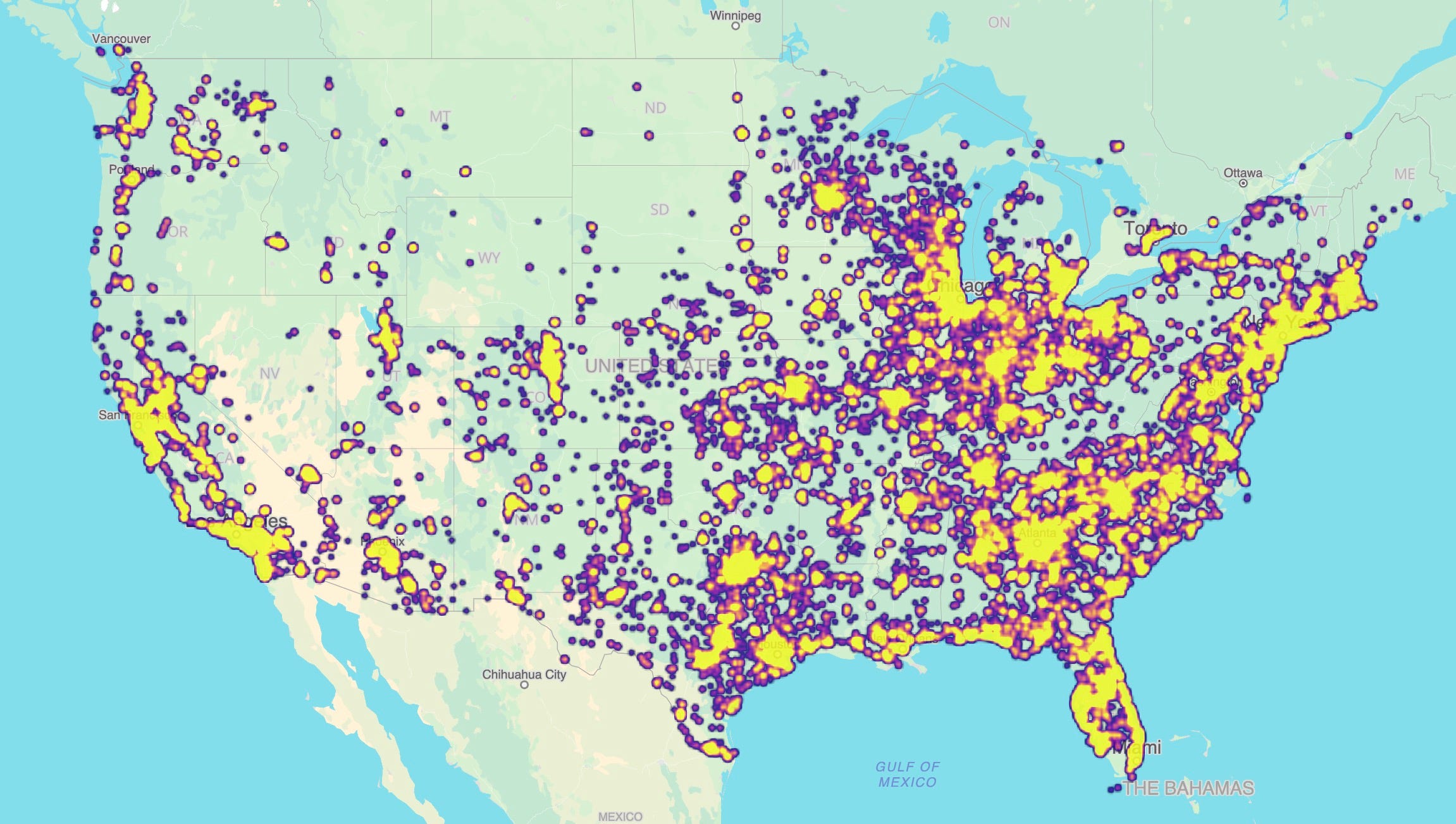
Fairness demands we grant Flock its strongest case. A shop owner who points a camera at his own parking lot is exercising his property rights, and sensibly so. Many police departments credit these systems with helping them investigate cases. Flock claims to have “supported more than 1 million investigations, assisted in solving 20% of cleared cases, helped locate more than 10,000 missing persons, and contributed significantly to stolen vehicle recoveries across the country.”
Langley himself puts it plainly: “Everyone wants to live in a crimeless society.” He is right about the desire. Nobody roots for the carjacker. The longing to be safe is among the most human of impulses, and any honest critic must concede that these cameras have, in particular cases, done genuine good.
But honesty cuts both ways, and the devices are no longer only what their marketing suggests. “License plate reader” undersells the machine considerably. Flock’s cameras record a vehicle’s make, model, color, dents, bumper stickers, and roof racks, creating a fingerprint that can be tracked even when the plate is not visible. And their cameras can also record the people inside their cars.
The company’s next product, Nova, promises to knit police records together with Social Security numbers, credit histories, and property data into one AI-searchable whole. And the cameras have migrated from highways to the places we go to escape being watched: parks, trails, playgrounds, libraries. Local governments plug into the network, share their feeds across state lines, and very rarely ask their residents first.
What happens when this much power sits in this many hands with this little oversight? We no longer have to speculate. Consider a brief inventory of the record so far:
At least 18 police officers, including multiple chiefs, have been caught using Flock to stalk ex-girlfriends, spouses, and romantic rivals, sometimes running a single plate hundreds of times.
A Texas sheriff’s office searched 83,000 cameras across the nation hunting a woman who had taken abortion pills; the stated reason in the log read “had an abortion, search for female.” Officials claimed a welfare check, but court records later showed police had weighed criminal charges.
In Dunwoody, Georgia, records revealed Flock’s own employees accessed the city’s cameras regularly (reportedly over 1,000 times), including a camera inside a children’s gymnastics room, while the company’s FAQ had promised that “nobody from Flock Safety is accessing or monitoring your footage.”
Federal immigration agents tapped the network in states whose laws forbade it, prompting Illinois to audit and expel dozens of agencies from its data.
Each incident was predictably dismissed as an aberration. But together they form a pattern, and the pattern is the point: infrastructure this powerful will be abused because it is operated by fallible human beings and checked by almost nothing.
Where does the road lead if we keep driving? Look at London, the CCTV capital of the Western world. Nearly a million cameras watch nine million residents, roughly one for every ten people; the average Londoner is recorded about seventy times a day. Yet researchers find little correlation between camera density and crime rates. The cameras did what cameras do. They watched everyone, and criminals adapted, and the dragnet stayed.
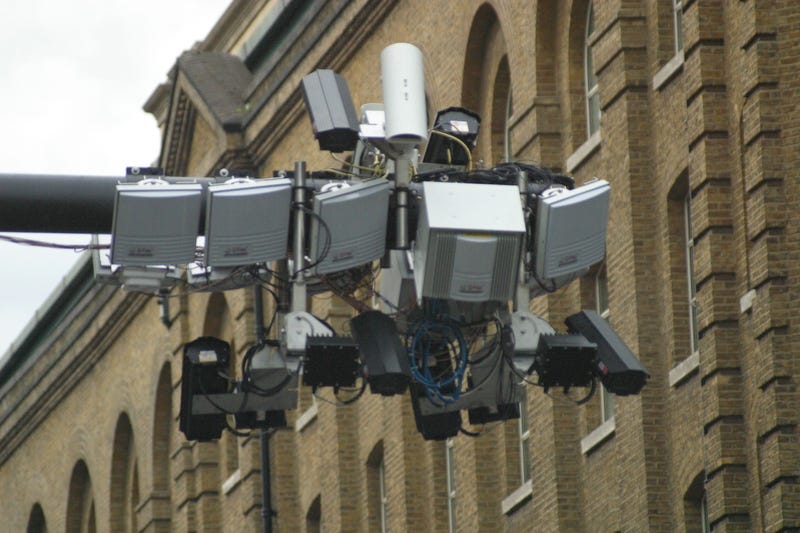
Nor is this some distant foreign cautionary tale. Flock’s own hometown of Atlanta is now the most surveilled city in America, with 124 cameras per 1,000 residents; worldwide, only cities in China watch their people more closely. The panopticon has a zip code, and it is domestic.
Langley believes that “Safety is a fundamental right.” He simply wants a world where people are kept safe, and I take him at his word. But that is precisely what should trouble us, because the urge to be kept safe is the campaign fodder for every tyrant in history. No regime ever announced itself as an oppressor; each arrived promising protection from crime, from chaos, and from enemies within. The Stasi kept East Germans very “safe” from one another. The question a free people must ask is never whether surveillance can prevent some harm. Of course it can. The question is what kind of people we become once we accept being tracked, logged, and cataloged as the price of admission to public life. A society where every trip to a church, a gun store, a clinic, a protest, or a political meeting enters a database is a society where dissent grows quietly expensive. Anyone with a modicum of historical knowledge knows how that story ends, and it does not end with safety.
There is resistance. Langley’s reaction to calling DeFlock a “terroristic organization” stemmed in part, no doubt, from how some individuals are using its information to disable these surveillance systems. (I should point out that while Langley and others see this behavior as itself criminal, our very country, whose anniversary we just celebrated, was founded by patriots engaged in similar activities in the name of liberty.)


On the more peaceable front, more than fifty cities have canceled, deactivated, or rejected Flock contracts after residents mounted pressure. City councils respond to rooms full of neighbors in ways no federal agency ever will. Concerned citizens should (at a minimum) demand legal reforms that:
require a warrant to use data from these devices;
impose short retention windows after which the data must be purged; and
require publicly available audits of how the systems are used and for which types of investigations.
I should note that for years, our team at Libertas Institute has been passing and promoting legislation in states across the country to protect privacy. Flock’s rapid expansion of surveillance systems catches many communities off guard. Private companies develop (and law enforcement agencies begin using) new tools and technologies far faster than committees and councils and citizens can typically keep up. More work is needed, and Libertas will be engaged on this topic.
The Fourth Amendment was written on the premise that a free people are entitled to be left alone absent particular (read: individualized) suspicion. Which returns us to the man with the map. Telling your neighbors where the cameras are is among the oldest of American instincts: the refusal to be governed in the dark. (And what some choose to do with that information, including destroying them, is borne—much to the chagrin of Langley and law enforcement—of a related American instinct.)
Perfect safety has never been on the menu of human life, and the societies that chased it hardest made themselves miserable without ever catching it. What is on the menu is a choice older than the republic: whether we will live as free people who accept the risks freedom carries, or as monitored people who traded their birthright for a promise neither Flock nor their friends in law enforcement can keep.
Our ancestors made that choice under far graver dangers than ours, and they left us a clear answer, one best articulated by Franklin: “Those who would give up essential Liberty, to purchase a little temporary Safety, deserve neither Liberty nor Safety.” The least we can do is decline to auction off our liberty, one pole-mounted camera at a time.
It has no case. Where I live, there are two of them on a rural highway in a no-crime area, one at a signaled intersection whose highlight is the gas station and Subway, and two more on another rural highway near absolutely nothing. They're not there to prevent crime and assist in it; they're simply tracking people for no good reason.
Plus, per United States v. Jones, 565 U.S. 400 (2012), "The Fourth Amendment provides in relevant part that “[t]he right of the people to be secure in their persons, houses, papers, and effects, against unreasonable searches and seizures, shall not be violated.” It is beyond dispute that a vehicle is an “effect” as that term is used in the Amendment." Flock is, in effect, a private search, and that's a rights violation that is quite defensible.
The people taking these things out are true patriots.
Fuck Flock. Don’t want to live in a surveillance state.