

Gallup released its annual labor survey last week in advance of today’s holiday. According to their poll, 71 percent of Americans approve of labor unions, matching the highest reading since the 1960s, and a record 47 percent want unions to have more influence than they do today. Yet only one in ten workers belongs to one. Approval has rarely been higher. Membership has rarely been lower.
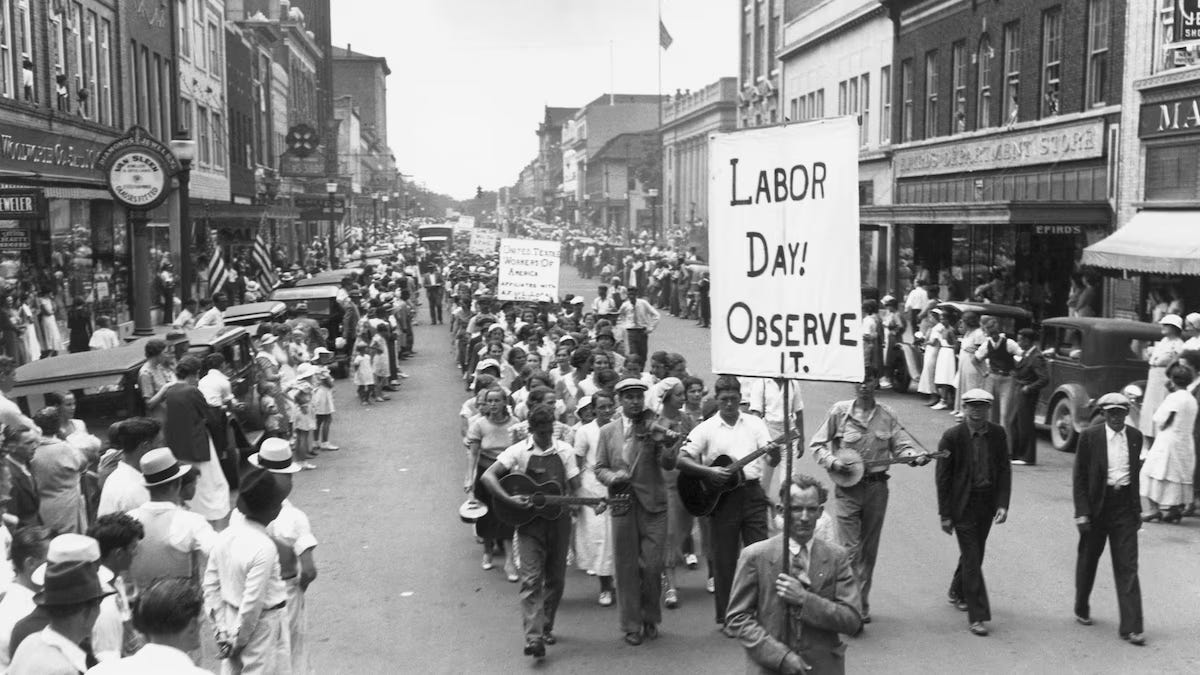
That gap is a good reason to ask what, exactly, today is celebrating. Most Americans will take the day off of work. Fewer can say, with any confidence, why this holiday exists. Labor Day has become the civic cousin of the Fourth of July barbecue: a long weekend, maybe a mediocre parade, and a foggy sense of the historical events that produced the annual recognition.
Before gaining government recognition, labor activists and select states organized Labor Day, with Oregon the first to pass a law recognizing it in 1887. By 1894, 23 more states had adopted it, and Congress made the first Monday in September a federal holiday that June. A century on, the day mostly means a generic salute to “work” and an extra day away from it.
First things first: yes, labor matters. Human effort turns resources into meals, houses, software, and surgeries. A society that despises work will not stay free or fed for long. But these points are distinct from the holiday’s preferred myth: that organized labor (i.e., unions), backed by government, is the main reason American workers live better than their great-grandparents did.
Living better results from rising wages (mo’ money, fewer problems), and wages rise when workers produce more. So what raises production per hour? Productivity rises when people apply better tools, better organization, and more savings to the same hours. That is capital. A ditch dug with a spoon is labor. A ditch dug with a machine is labor multiplied. For most of human history, sheer effort barely moved the food supply. The plow, the horse collar, later the truck and the silicon chip, changed what effort could buy.
Workers without capital look like subsistence: plenty of hands, few multipliers. Machines without operators are scrap. The two depend on each other (until Tesla Optimus robots start producing and maintaining themselves, anyway). But only one of them got a federal holiday. Celebrating labor while ignoring (or in many cases, criticizing) capital is like enjoying the shade and indicting the man who planted and nurtured the tree.
Unions still step into that shade and claim the credit. Labor Day gives them a bigger bully pulpit from which to argue that they speak for workers as a whole. But that claim does not survive scrutiny.

A union can raise pay for the people inside it, typically through exclusion. If you can keep other workers from competing for the same jobs, the remaining seats become more valuable (showing that even socialist pro-union folk implicitly understand basic supply-and-demand economics). That helps the members who kept their jobs. It does not help the applicant turned away, or the worker pushed into inferior employment alternatives.
The right of free association means people are free to join a union or walk off the job together. What they should not get, and do not deserve, is government help locking other workers out, then a holiday speech calling that the “voice of labor.” In the private sector, 94.1% of wage and salary workers are not part of a union! So, treating “union” and “worker” as synonymous is flat-out incorrect.
Here is the encouraging part from the Gallup poll. Eighty-one percent of Americans view free enterprise positively (against 54 percent for capitalism). Asked what's wrong with each, 23 percent name inequality as capitalism’s defect; only 9 percent say it of free enterprise. Americans have not rejected the thing. They have rejected a label, which means the case for capital is losing on superficial branding rather than on substantive merit. That is a far better problem to have, and a fixable one.
So what would a better Labor Day sound like?
We would thank people who show up and do hard work: the grocer, the trucker, the warehouse worker, and the engineer. Then it would go further. It would recognize and thank the capital allocators who saved and paid for the machines, the people who invented them, and the customers who choose to buy them. It would be a Labor+Capital Day, or perhaps better put, Market Day.
Prosperity rises as labor and capital combine. Contrary to the fantasy that Marxists have long concocted, the two are not at odds; they are codependent halves of the market miracle, creating a virtuous cycle whereby capital investment leads to more productive and prosperous labor, which unlocks more capital to invest in yet more opportunities to benefit all of us, workers and otherwise.
Workers matter, of course. So do the tools in their hands and the savings that paid for those tools. What made their hours able to feed and house a country was work joined to capital, under free exchange.
Drop the story that unions and government built American living standards by beating up on capital. And let’s remember what paid for the shade: work, yes, and the tools and savings that made that work worth far more than hands alone could produce.
I hope you enjoyed your Market Day Conner. Our family celebrated by buying more tools and working on family projects together on our homestead, then enjoyed a feast, a product of our labor.
Thanks for the insight 🤙