

On May 21, 2020, in his newly released pandemic diary, Anthony Fauci opens his daily entry with a ledger. Global COVID-19 cases. New cases. Deaths. Italy’s toll, now past China’s. The American numbers underneath. Then a line about the task force meeting, and a note that the press conference went well.
Then, with no transition whatsoever, the subject changes. A flattering profile has run on the front page of The Washington Post. His fame, he writes, has become explosive and unimaginable. It would not be hyperbole, he assures himself, to say that he is now “the most famous and talked about person in the country.” (This, in addition to calling himself “the most credible scientist in the world.” )
He was writing to himself. There was no audience to perform for, no interviewer to charm, no adversary to rebut. Whatever else the diary is, it is the sound of a man alone with his own thoughts, one paragraph below the day’s death count.
Senator Rand Paul, who chairs the Homeland Security and Governmental Affairs Committee, released the journals this weekend, days before Fauci is scheduled to testify under subpoena. Fauci's vanity is going viral on 𝕏 because vanity is easily observable, a little funny, and confirms what half the country already suspected about him. (Don't count on legacy media to notice; they were complicit in elevating him to saintly status in the first place.)
Yet the diary is the least consequential document in the release. The file that matters more came out a day earlier.
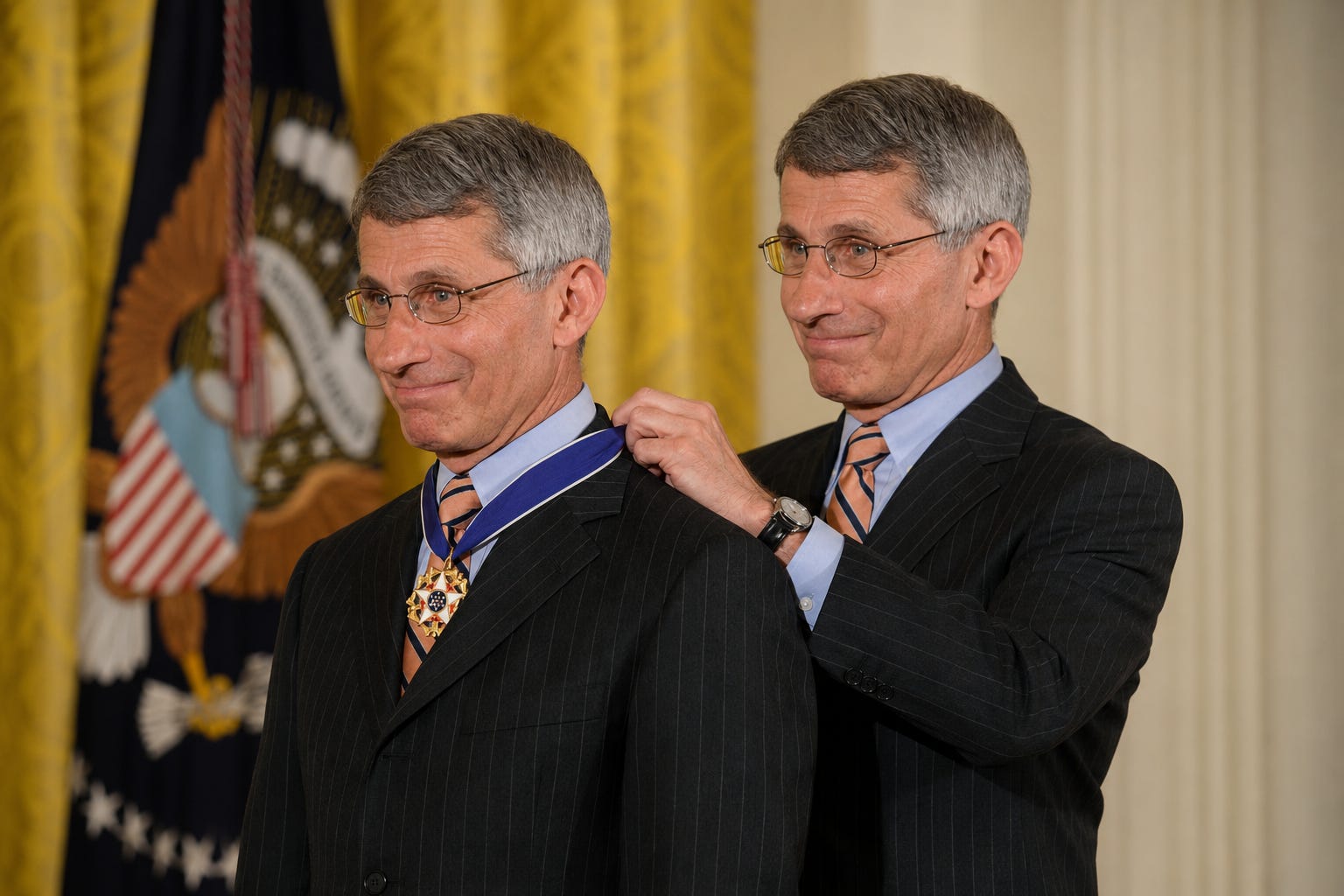
Anthony Fauci, the highest-paid official in the federal government, accumulated hundreds of thousands of dollars in cash prizes during the pandemic. NIH’s second-ranking official functioned as his personal awards manager. His taxpayer-funded staff drafted the nominations. The largest purse came from abroad: the Dan David Foundation, headquartered at Tel Aviv University, named him a laureate in February 2021 and wired him $900,000, the balance of a million-dollar prize after the foundation’s customary scholarship set-aside. The citation honored him for “defending science.”
Consider the optics of this. A federal employee’s salaried subordinates prepare his application for a prize. The prize is awarded. The honor then circulates through the press, and through the man’s own account of himself, as “independent” confirmation of his integrity. The laurel that was manufactured in-house comes back as evidence.
In October 2018, Fauci wrote to Barton Haynes of Duke asking Haynes to nominate him for the Shaw Prize; the same day, he floated the Heinz Award as a second target. The Shaw Prize discards self-nominations; the Heinz Awards forbid them outright. What the rules prohibit directly, a friendly phone call arranges indirectly. And why was the phone call so friendly? Because Haynes has won three consecutive grants from Fauci’s institute: $300 million in 2005, up to $139 million in 2012, and $129 million in 2019. More than half a billion taxpayer dollars moving in one direction, and a request for a prize nomination moving back the other. You scratch my back, I scratch yours.
So what, precisely, was the science he was being so richly rewarded for defending?
On January 31, 2020, according to his own diary, leading virologists told Fauci that the new virus carried a genetic feature raising real doubt about a natural origin. Roughly half the scientists on that first call thought the thing looked like it was created in a lab. Yet Fauci spent the following years telling the public the question was settled and treating those who were skeptical as cranks.
The authors of the paper he cited as independent proof were, in their own internal messages, assigning the lab-leak hypothesis odds of thirty percent, twenty percent, or just ten percent, while their published conclusion ruled it out. That same group discussed staying off email and curating their messages with an eye toward future records requests. (Oops.) Fauci had already set the tone. In a February 2020 email, he instructed the director of NIH to “please delete this e-mail after you read it.”
Something clarifying happens as you read through these documents. They stop being a story about one man’s (deficient) character and become a story about a system doing exactly what it was built to do. Institutions produce whatever they pay for, and this one paid for prestige. Prestige requires certainty; certainty cannot survive open questions; therefore open questions had to be reclassified as threats. (Remember what Fauci said in November 2021? “They’re really criticizing science, because I represent science.”)
This is what made “trust the science” so useful to the people who said it. Science is a method of doubting things, but what was on offer in recent years was deference to a handful of officials whose budgets, reputations, and prize money all depended on a single answer being correct. When Elon Musk tweeted in December 2022 about prosecuting Fauci, a former CIA director rushed to call him a national hero who would be “remembered for generations to come for his innate goodness & many contributions to public health.” The speed of that deification (innate goodness, lest you forget!), from a CIA swamp rat whose profession is deception, tells you the dispute was never really about actual evidence.
And notice who is silent about these new documents. The private records of the central figure in the defining event of the 21st century have been publicly released, and the institutions that praised and flattered Fauci have nothing to say. The material does not fit the narrative they so carefully crafted, so a story that was never supposed to become news is quietly ignored as if it were no news at all. Legacy media has cultivated quite the “legacy.”

What was done in service of this manufactured certainty? Schools shuttered for a year and more. Businesses closed, some of which never reopened. Seniors denied access to visiting family and funerals held over video. Neighbors reporting neighbors. A generation whose formative experience of civic life was watching adults obey instructions (that the instructing adults privately doubted!). Whatever the virus actually did on its own, much of the resulting damage was authored by people whose private notes recorded uncertainty while their public platforms admitted none.
Anger is the natural response and the least useful one. Removing one man solves very little, because the incentives that produced him are still in place and recruit new successors. Any institution permitted to fund the research, define the consensus, and police the dissent will eventually generate whichever answer preserves its position. Incentives do not require villains. They only require time.
Richard Feynman, addressing Caltech’s graduating class in 1974 on what he called cargo cult science, gave them a rule: the first principle is that you must not fool yourself, and you are the easiest person to fool. His point was that science is a discipline of institutionalized self-distrust, engineered to frustrate the human appetite for being right. He closed by wishing them the luck to work somewhere that would never force them to trade integrity for position or funding. These documents describe a discipline running backward: an apparatus organized to protect a conclusion, reward its defenders, and suppress its doubters.
The harder question is, why were most people so ready to be told? A frightened country wanted a face and a settled answer—an expert who could speak confidently about the problem and its solution—and an industry of prizes, profiles, and prime-time bookings obligingly supplied both. Fauci is the byproduct of a broken society unable to think and decide for itself.
Feynman prescribed a temperament, and temperaments are best formed early. A person who has learned to distrust himself (as well as—nay, especially—“the experts”) is not easily governed by manufactured consensus, because his instinct is to check the manufacturing. That habit is taught in the unglamorous work of raising critically thinking children who treat a credential as a claim to be examined rather than a verdict to be obeyed. (Which is precisely the habit a compliance-trained, credential-worshiping school system exists to breed out of a child.)
Which brings us back to Fauci, logging the day’s dead in one paragraph and his own fame in the next. That juxtaposition is the whole lesson in miniature: he had fooled himself first, and a country too credulous and too out of practice at doubt was in no condition to catch him.
A free people cannot keep the powerful from fooling themselves. It can, and must, decline to be fooled alongside them.
In 2024, due in large part to Fauci’s deceptions, I felt compelled to write Mind Wars: Avoiding Deception in an Age of Manipulation. After reviewing examples of how the masses have been manipulated by those in power, I share ways we can fortify our minds against those who aim to deceive.
Spot on. I appreciated this essay immensely
Famous for being famous.
It is unethical to accept money for public service beyond your wage. Corruption abounds.