

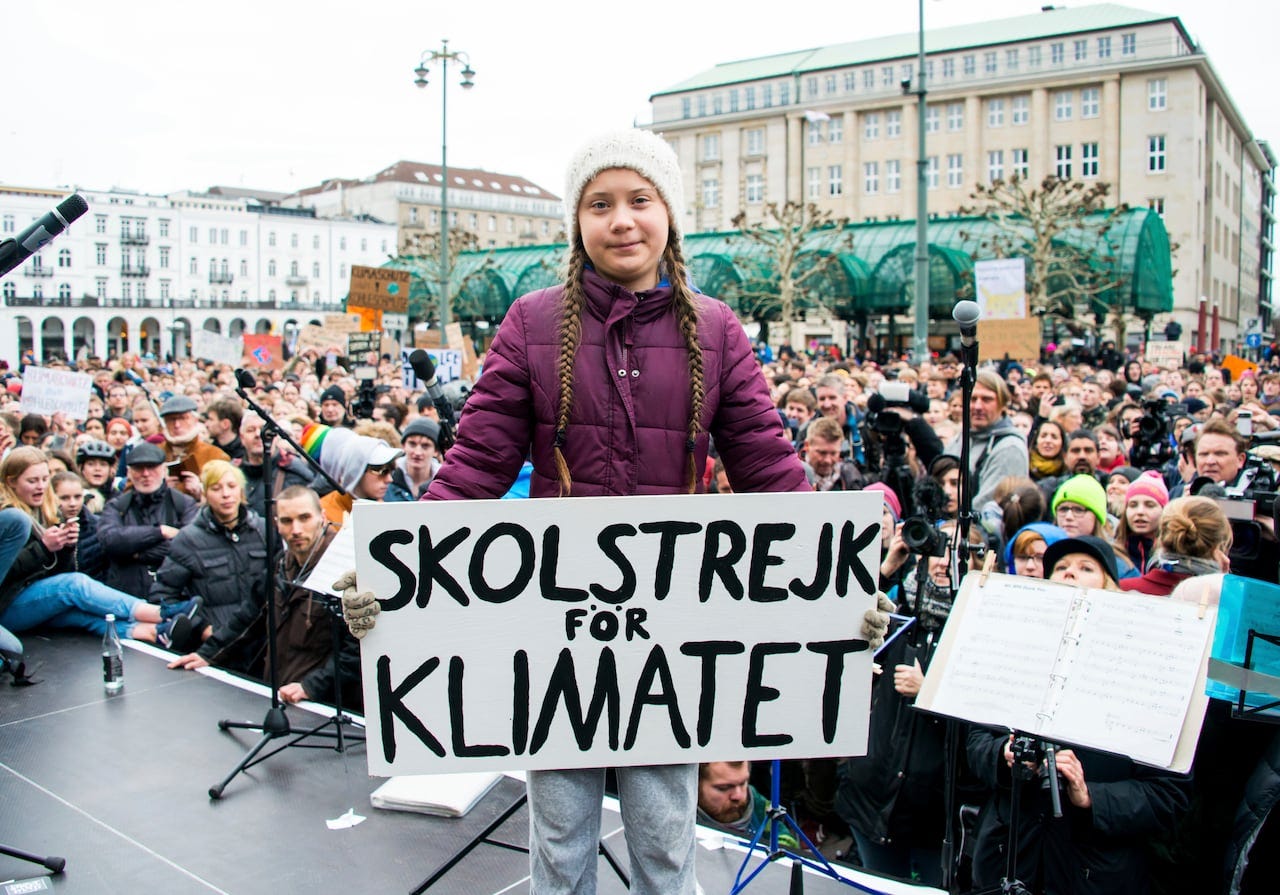
In a German documentary released on YouTube last month, Greta Thunberg recounted the familiar charge that climate activists had been radicalized and now wanted to overthrow capitalism. Her simple reply: yeah, we wanted that from day one. In another scene from the same film, when told that a “Fridays for Future” march was underway in Berlin that day, Greta, the movement’s founder, was surprised people were still participating and collapsed into laughter.
The girl who once scolded the United Nations with “How dare you!” now regards the school strikes as quaint, because she has graduated to the real project. The marches were merely an overture. The revolution was always the opera. Radical political change was the goal from day one.
The issue is rarely the issue; what’s presented openly at first is often a front for something more sinister. So what, across half a century of apocalyptic deadlines, has the issue actually been?
First let’s recall Paul Ehrlich, who opened The Population Bomb in 1968 by declaring the battle to feed humanity lost and promising that hundreds of millions would starve in the 1970s. By the time Ehrlich died this past March, the record was almost laughably opposite of everything the man predicted: the global death rate had fallen by a third, the share of undernourished people had collapsed, and life expectancy had climbed sixteen years. Ehrlich never recanted. He simply moved the deadline while reaffirming his remedy: population control, by compulsion if necessary.


Then came Al Gore, who parlayed An Inconvenient Truth into an Oscar, a Nobel Prize, and the status of secular prophet of sorts. At the 2009 Copenhagen summit, he told delegates there was a 75 percent chance that the entire North polar ice cap would melt in summer within five to seven years. (Never mind that the scientist whose modeling he invoked publicly objected that his work supported no such figure.) As with Gore’s other catastrophic predictions, this one utterly failed. 2014 came and went, and the Arctic kept its summer ice.
Then came Thunberg herself, who in 2018 claimed that climate change would wipe out all of humanity unless fossil fuel use ended within five years. Wouldn’t you know? Five years came and went, and as the deadline approached, she deleted the tweet to avoid accountability. (But the internet lives forever…) Yet Parliaments applauded her, classrooms enlisted her, and “listen to the children” became a way to end arguments rather than have them.
What’s predictably consistent across these and other climate doomers is that the deadlines move while the prescription doesn’t. Each prophecy, whatever its particulars, arrives with the same demand: increased government authority over energy, industry, and how ordinary people travel, eat, and live. But when a theory’s predictions fail decade after decade while its prescriptions (and the policies they produced) survive untouched, one might reasonably conclude that the predictions were never the point.
Which brings us to Antalya this past weekend, the Turkish resort city hosting COP31, the United Nations’ Convention on Climate Change, where Thunberg herself turned up. The summit involved a record 93,000 participants, with more than 150 private jets shuttling the event’s elite. After two weeks of talks, the summit’s president conceded there was no consensus and declined to draft another statement for consideration, the first such situation since Copenhagen in 2009 (which was, interestingly, the summit where Gore delivered his ice-cap prophecy).
The planet, we are repeatedly told, cannot wait. Yet the conference circuit can wait indefinitely; next year the caravan will reassemble somewhere else, with more delegates demanding more control over more lives. A movement this immune to failed forecasts and collapsed summits is fueled by something other than rigorous data and open inquiry. It instead runs on a creed, an old one that has become increasingly popular of late.
There’s one answer to all three open threads. What was Thunberg and her allies’ goal from day one? What is the real issue behind the façade? What creed keeps doomers moving their goalposts as they pursue political power? The answer is Marxism.
For her part, Thunberg has never called it Marxism. She hardly needs to. At a 2022 book launch in London, Thunberg described the “normal” order that produced the climate crisis as a system of colonialism, imperialism, oppression, and worse. That is Marxism’s native grammar, casting history as a contest between oppressor and oppressed, the existing order as the original crime, and revolution as redemption. The old Marxism promised that the workers would rise. When capitalism instead made the workers prosperous, the revolution needed a new emergency and a new constituency. The climate supplies both: a crisis vast enough to justify nearly any control, and permanent enough that it never has to end. It’s a gift that keeps on giving.
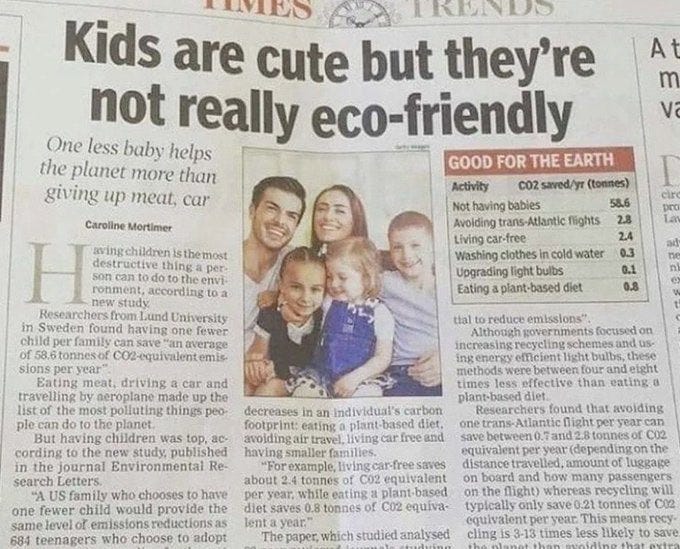
The deepest target, though, lies closer to home. Marx and Engels were candid in 1848: “Abolition of the family! Even the most radical flare up at this infamous proposal of the Communists.” Today’s movement is subtler, but its arithmetic remains the same. A widely publicized 2017 study ranked “having one fewer child” as by far the most effective climate action available to individuals, worth roughly twenty-four times the benefit of giving up a car. A 2021 survey in The Lancet Planetary Health of 10,000 young people across ten countries found that 39 percent were hesitant to have children because of climate fears. So-called “climate anxiety” is a major contributor to declining fertility rates across the globe.
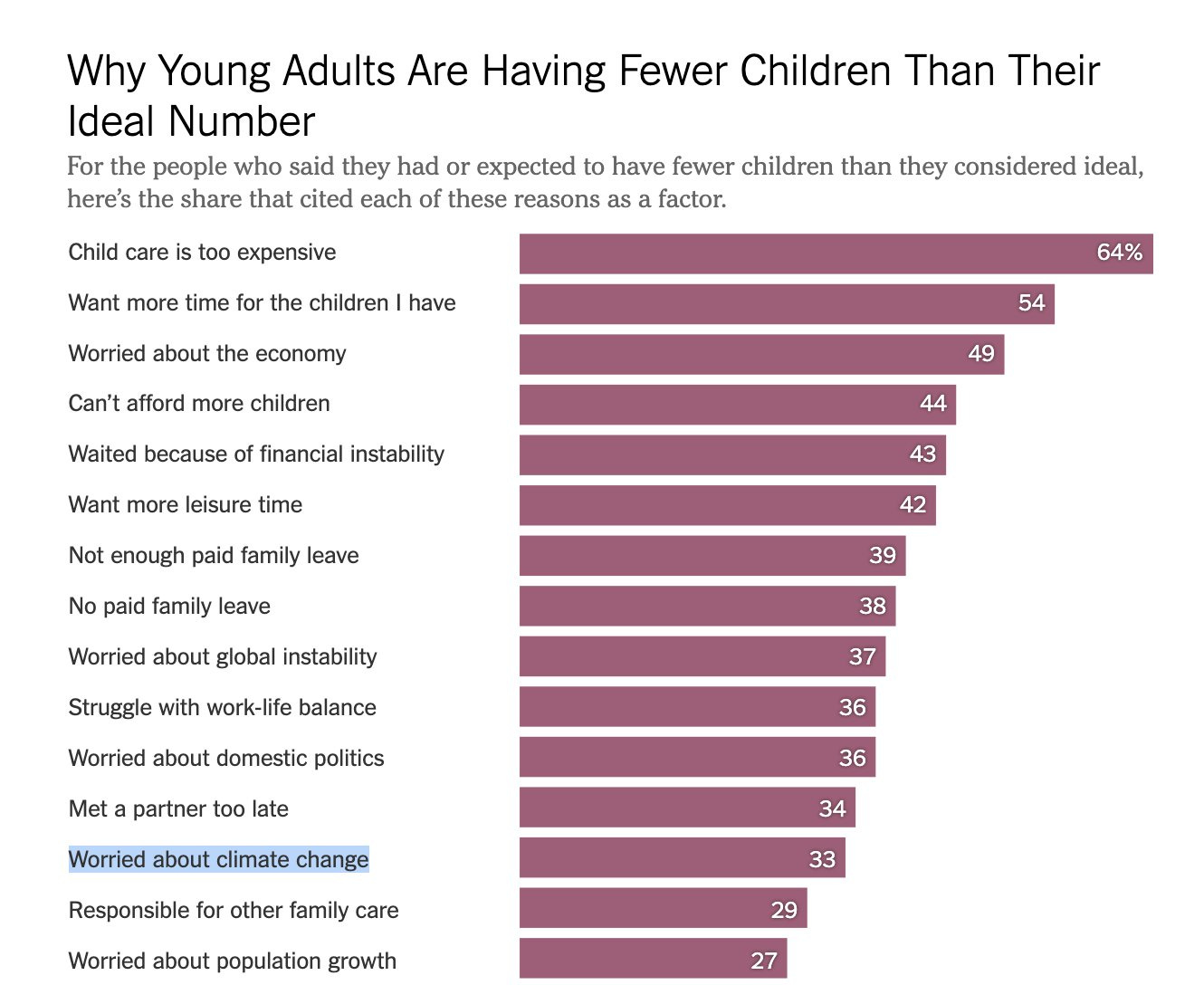
An entire generation has been taught to see its own sons and daughters as emissions, and to approach the most hopeful act available to human beings as an act of pollution and earthly corrosion. The family could be hollowed out without a single political decree; it was enough to persuade the young that the family was a carbon liability, and then let fear finish the work. Ehrlich’s coercion, it turns out, may never be required; anxiety proved cheaper.
The new Marxism is culturally spread and enforced. Orwell imagined tyranny as a boot, and in certain situations that remains true. But Huxley saw that a society could be steered more gently, by people who learn to want what their rulers want. The climate movement chose Huxley’s path. A young couple that forgoes children out of eco-guilt has obeyed a decree nobody had to issue.
When confronted with the next climate deadline or purported emergency, we should help our children ask three simple questions. What did the last would-be prophets predict, and did it happen? Who gains power if this proposal is enacted? And what does this proposal impose on my family?
Orthodoxies have always resented such questions; Athens executed Socrates for corrupting its youth, which is to say, for teaching them to ask. Every creed that runs on fear depends on people who won’t ask. That is why the great dystopian novels keep returning to the same hero. Orwell’s Winston Smith keeps a forbidden diary. Bradbury’s Montag reads the books he was paid to burn. In Lois Lowry’s The Giver, a twelve-year-old named Jonas discovers what his tidy, managed community has hidden from him. Across dystopian literature, the regime controls energy, food, and family. But what the regime most fears is a single person who asks whether the official story is true. A child trained to ask that question cannot easily be stampeded by climate catastrophists, or by anyone else.
Greta Thunberg told us what her movement wanted from day one. Our children should be prepared to offer a better answer: a future worth inheriting, the freedom to build it, and the clarity to recognize any creed demanding they surrender both.
Ground your kids with sound principles and true history so that they can recognize and reject the false ideas that bombard them daily. The Tuttle Twins has a massive Black Friday sale going on this week. (Grab some extras as well — they make for great Christmas gifts!)

"The Population Bomb" was required reading for my first semester of college in 1969. This propaganda has been doing it's pernicious work for generations.
Beautifully said