

At an Independence Day celebration this past Saturday, the food, fireworks, and family fun, though enjoyable, couldn’t pull me out of my head. I was preoccupied with the history and the math.
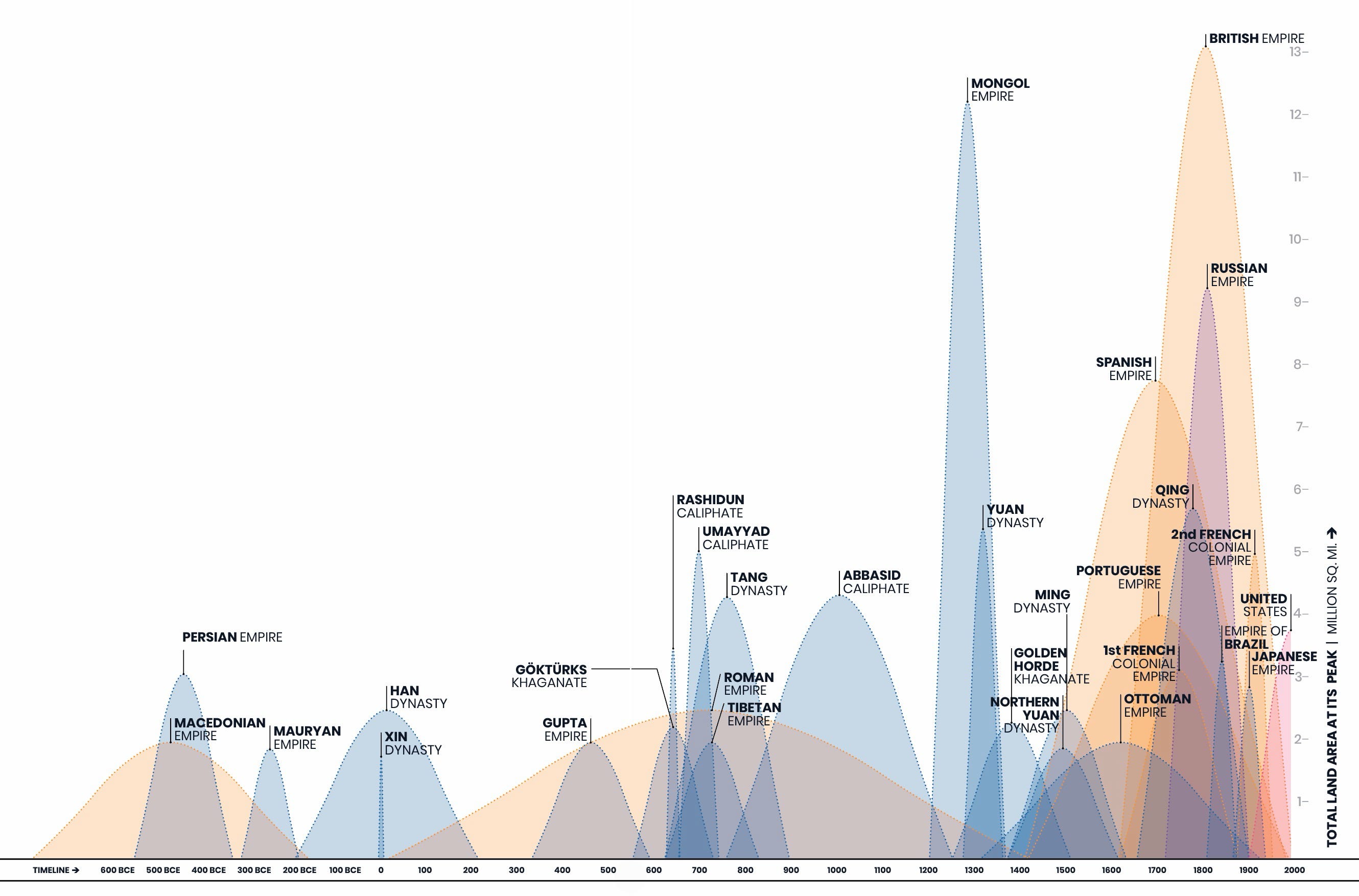
You see, there is a grim regularity to the lifespan of great powers. Sir John Glubb, a British officer who spent his retirement surveying the wreckage of empires from Assyria to his own, concluded that the average dominant power endures about 250 years, roughly ten generations.
Samuel Arbesman, examining 41 empires across three millennia, landed on a similar number. Chart their rises and falls and you get a horizon of overlapping arcs, each cresting and collapsing with almost embarrassing consistency (see below). Nations ascend, plateau, then decline, gradually and then all at once. Note America at the end (of the chart, heh…).
Many of the founders would not have been surprised. They were morbidly fluent in the failure of republics. They studied Athens and Rome as cautionary tales rather than curiosities, and they built accordingly. What they feared was never foreign conquest so much as domestic complacency: a people grown too comfortable, and too incurious, to know why liberty was worth the trouble and what’s required to preserve it.
Franklin’s famous warning, “a republic, if you can keep it,” carried no rhetorical flourish. It was a job description of sorts, handed to every generation that would follow.
So how is the present generation performing? Consider an awkward birthday statistic.
A new Cato Institute survey, released on Friday, found that 46 percent of Americans cannot even say what the 250th anniversary actually commemorates. Among Gen Z, that figure rises to 61 percent. Fewer than four in ten young Americans can identify the adoption of the Declaration of Independence as the occasion we are celebrating with parades and pyrotechnics.
(This is why, I’ll briefly note, our America’s History Tuttle Twins series is so critical, helping the rising generation learn history through storytelling—a strong antidote to dry textbooks. Volume 3 just launched last week and there’s a sale right now.)

Young people are seven times likelier than their grandparents to believe the founders acted chiefly to pad their own fortunes. Barely half of Gen Z counts the ideals of 1776 as part of their own inheritance, against 88 percent of seniors. And in the cohort that will superintend America at its 300th birthday, socialism now polls better than capitalism.
Here’s my thesis, in short: A civilization that cannot even explain itself to its children has already begun to end.
Civilizations do not fall because the barbarians grow stronger. They fall because the heirs grow indifferent. Education degrades from the formation of character into the accumulation of credentials (if even that). History becomes a dusty file cabinet of antiquated anecdotes, easily archived in favor of the seductive now. The common story dissolves into competing tribal ones, and a people who no longer share a past discover they cannot agree on a future.
And here is the consolation the arc of empires conceals: the pattern is descriptive, not prophetic. It records what has happened, never what must. Decline is a choice, assembled from a thousand small surrenders. And if decline is a choice, so is renewal.
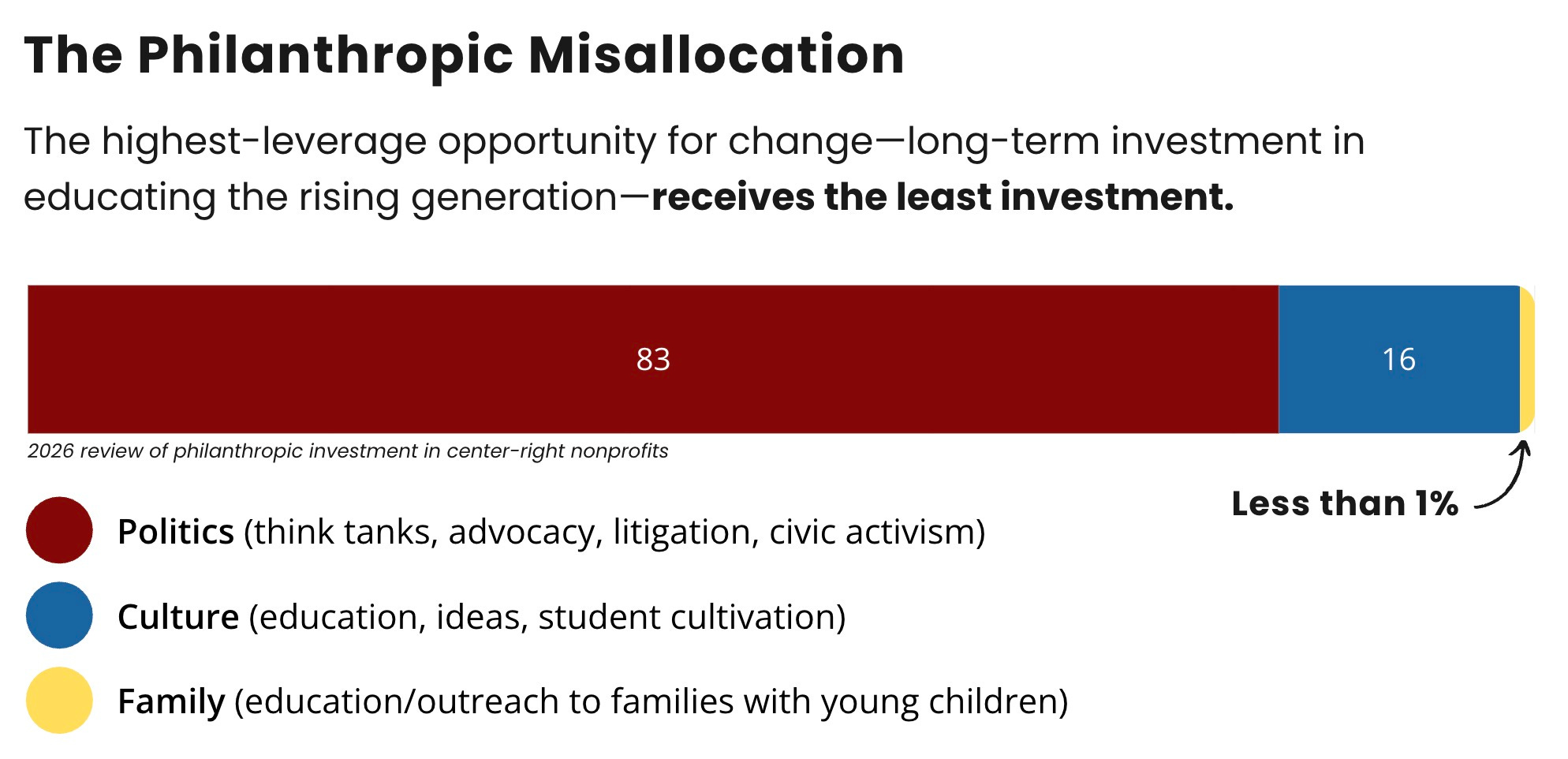
That renewal, I believe, must happen upstream of where most people focus. Politics captures our attention, money, and care. But this constant squabbling is downstream of the cultural forces that influence it, which themselves are downstream of the family. This is where the battle for America’s preservation truly lies.
I see this as a tragedy: We pour fortunes into short-term political fights and nearly nothing into forming the next generation. We fight over the harvest and neglect the planting. This isn’t me just opining; it’s what the data shows. Here’s where the money currently flows in right-of-center organizations focused on freedom (taken from a slide deck I’ve shared with a few of Libertas Network’s donors):
The most consequential efforts of the next 250 years will not occur in any capitol, courtroom, or classroom. It will occur at kitchen tables and in curricula, in the ordinary handing down of ideas from those who hold them to those who do not yet. Asked in that same survey what they most want children to learn from this anniversary, Americans’ top answer was this: that freedom is rare and must be protected. They know what is needed. The question is whether we will build the means to deliver it.
As we celebrate America’s 250th, I think of what it will take to perpetuate classically liberal values—free speech, property rights, free enterprise, and more—for another 50, 100, or 250 years. Can America beat the trend? Can it survive longer than the average civilization?
Answering that requires us to confront this simple truth: No free society has outlived its own ignorance of the values that gave it life.
The founders built the first 250 years. They did it deliberately, against long odds, with clear eyes about how fragile the whole experiment was. The next 250 are our assignment. The hour is late, but it is not too late, and a birthday is as good a moment as any to begin.
Franklin's job description has come due again, and the question, as it has always been, is whether we will keep it.
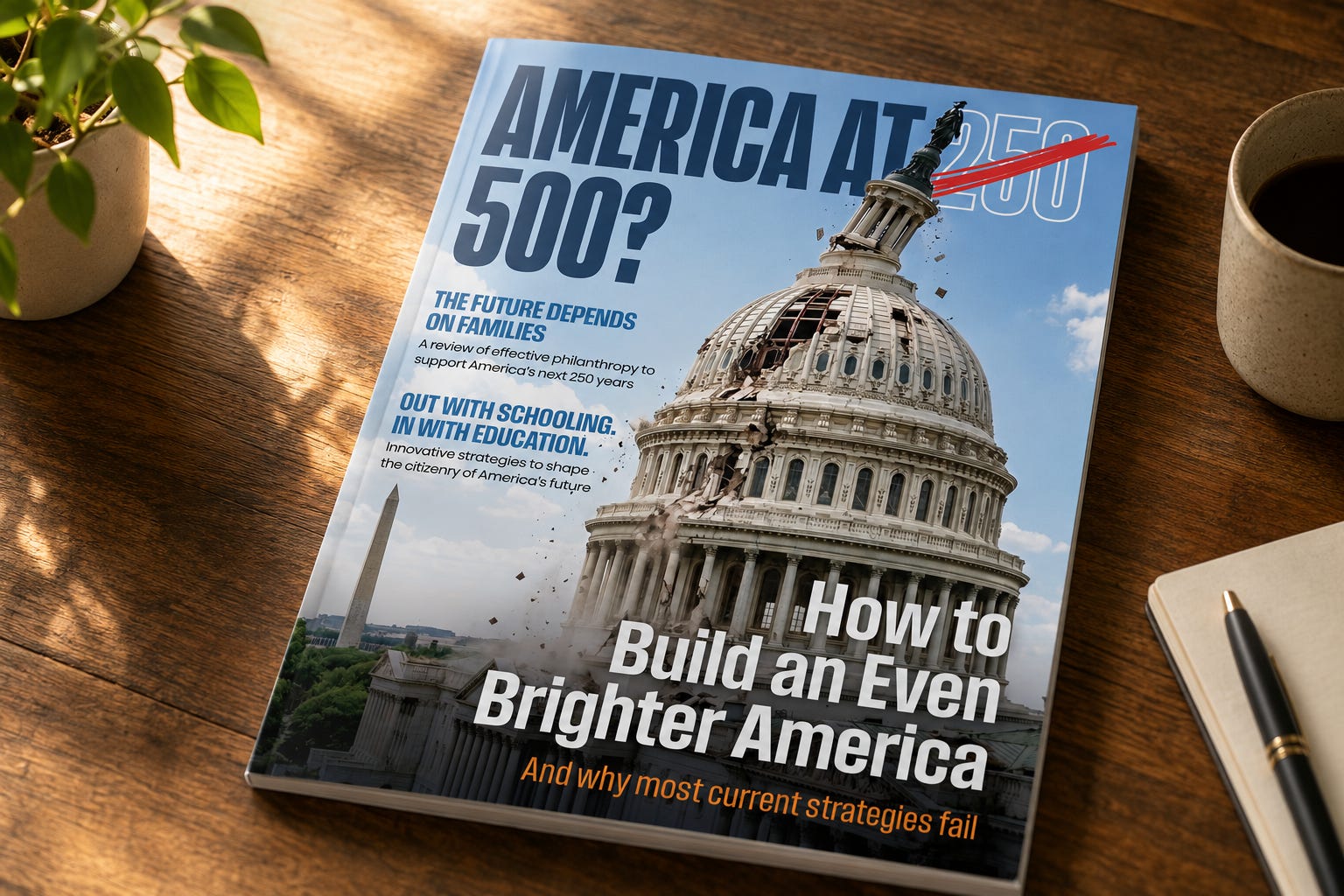
P.S. This topic is the theme of a new, single-issue magazine we’ve mailed out to a few donors and friends. Here’s the PDF.
If you’ve read this far, I’m excited to share that there’s more to come. This is the first of a new weekly newsletter I’ll be sharing commenting on current events, providing behind the scenes updates of our work, and breaking down complex ideas into simple, self-evident truths that you can communicate to your children.
Excellent thesis: "A civilization that cannot even explain itself to its children has already begun to end."
When I was in university (History major) I contemplated a similar thesis but was 'advised' out of it because the developing political climate within the university at the time, as I was advised, (and it only got worse since)would surely fail me for being politically incorrect. Pleased to see someone else had the balls to write about it.
Thanks, Connor. I have a question. My observation is that "free speech" is both an essential blessing and (as currently defined by the Supreme Court) an unavoidable curse. Can you imagine Xi allowing the postmodernists to invade Chinese universities and teach the educators to teach the children that the country's founders were corrupt men, that there is no truth except power, and that their culture is in no way superior to any other? With regard to free speech (or the absence thereof), in our ongoing competition with China we're like a boxer with one arm tied behind him.
"Fixing" education is obviously essential. But education (public education at least) is downstream from what's happening in the universities, and they seem, despite Trump's spanking, to remain wide open to malignant ideas. What more can be done to buttress the public mind in favor of sound ideas or inoculate it against malignant ones?
I think the Supreme Court went off the rails when it extended the liberty of free speech and press to broadcast media. Tucker Carlson spewing toxic ideas into millions of gullible minds daily bears little resemblance to the Founders' intention to guarantee a person's liberty to speak his mind in the local public square with his unamplified mouth.
I agree that family and education are foundational. But it will take a generation to grow a new generation. In the meantime, America may collapse from the rot in its superstructure... unless we can find more effective ways to advantage culturally adaptive ideas in the zeitgeist. -Dan